
The American dream of homeownership is “alive and well,” according to Mary Lee Blaylock, president of Coldwell Banker Affiliates, but it looks a little different —with parents starting to save for their children’s future homes before they reach kindergarten.
“It’s still there. It’s just we have to kind of slice it a little differently now,” Blaylock said of the American dream.
Eighty-two percent of parents with children 5 and under are saving or have considered saving for their child’s future down payment, according to Coldwell Banker’s 2026 American Dream Report. The survey, which was conducted by The Harris Poll and polled 2,060 U.S. adults from Sept. 8-10, found 85 percent of Americans say homeownership is part of the American dream, unchanged from last year.
Fourteen percent of those parents have started saving for a down payment, compared with 20 percent saving for their child’s college and 28 percent saving for their own retirement. Among all parents, a child’s future down payment (56 percent) ranks alongside college (51 percent) and a first car (49 percent) as something they’ve considered saving for.
“What surprised me most about it is that there is a new trend emerging … of young parents of young children who are starting a college fund and a homeownership down payment fund before their children ever start kindergarten,” Blaylock told Inman.
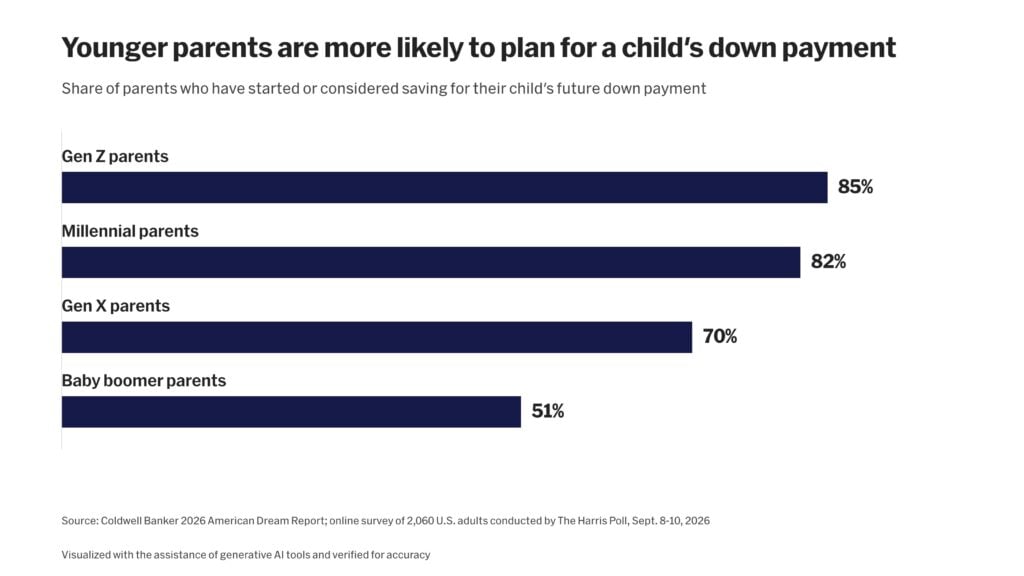
Younger parents are most likely to plan ahead. In fact, 85 percent of Gen Z parents and 82 percent of millennial parents have considered or started saving for a child’s down payment, compared with 70 percent of Gen X parents and 51 percent of baby boomer parents, according to the report, likely reflecting those younger generations’ less hopeful views of the likelihood of actually owning a home without outside help.
That planning reflects a longer path to a first purchase. In fact, more than half of aspiring first-time buyers (53 percent) expect to be 40 or older when they buy, unchanged from last year.
“Now buyers have to have a longer runway, meaning that it may take longer to get that down payment,” Blaylock said.
Personal savings remains the most common down payment source, with 44 percent of Americans using or expecting to use it, compared with 17 percent who used or expect to use a gift or loan from family or friends.
“The number one source of down payment still remains the individual’s down payment and savings account,” Blaylock said. “It might be supplemented from family, not replaced by family. So it’s … more of a communal effort today than it was 30 years ago.”
By the numbers
- 82 percent of parents with children 5 and under are saving or have considered saving for their child’s down payment
- 89 percent of Americans call buying a home an admirable achievement
- 85 percent say homeownership gives a sense of security renting can’t
- 80 percent would choose to own their home if cost weren’t a factor
- 73 percent of Gen Z say buying a home means you’re financially secure, compared with 59 percent of baby boomers
- 76 percent of mortgaged homeowners say they would stay in their current home, even if they wanted to move, to keep their rate
- 36 percent say enough bedrooms for everyone would make them feel they had achieved the American dream, followed by a large kitchen (34 percent) and a big backyard (33 percent)
Source: Coldwell Banker 2026 American Dream Report
Family help comes with terms
Fifteen percent of homeowners received money from family or friends for their down payment, a figure that rises to 26 percent among Gen Z homeowners specifically. Seventy-one percent of those who received family money are expected to pay it back. Half of Americans (51 percent) have helped fund a relative’s down payment or considered it.
Blaylock said family involvement adds parties to the transaction from the start.
“They might be part of the decision-making process initially,” she said. “So there’s more parties to talk to and more people to understand what the needs are and what they’re getting into.”
She advised buyers and family members to set expectations at the outset.
“Communication is key. What are the expectations? Are they expected to pay it back? If so, by when?” Blaylock said.
“Put it in writing,” she added. “All parties agree and understand what that means.”
Co-buying expands beyond family
Seven percent of Americans have co-bought or are co-buying a home with a friend or other non-romantic partner, up from 4 percent in 2025, according to the report.
“They’re not … involved as a romantic partner, but they are a homeownership partner, and those people are planning ahead from pooling their money together, but they also need to plan ahead for the day that one of them wants to move out, and how will that work,” Blaylock said.
She said agents should walk co-buyers through scenarios before they close.
“If there’s an improvement made on that property while they are co-owning that home, who’s going to pay for it? How is it going to get paid for? And how will that benefit work if one of the parties leaves the home and gets cashed out?” she said.
Blaylock also recommended co-buyers consult an attorney.
“You want to make sure that things are worded in a way and dealt with in a way that you anticipate and avoid hardship,” she said.
Affordability shapes the path
Sixty-three percent of Americans say buying a home in the next year would leave them house poor. Among non-owners who want to buy, fewer cite high home prices (47 percent, down from 56 percent) and high interest rates (35 percent, down from 46 percent) as barriers compared to a year ago. Twenty-nine percent cite economic or job uncertainty, a new question this year, and 16 percent cite insurance costs.
Many parents face pressure from two directions, representing the so-called “sandwich generation.” Fifty-two percent of parents with children 5 and under expect to support an aging parent or relative financially within five years.
Gen Z respondents are making their own adjustments. Seventy-six percent have considered moving in with parents or in-laws to save for a home, and 27 percent have done so or are doing so now. Among Gen Z non-owners, 92 percent want to buy someday, and 28 percent would choose a dream home over a dream job.
“People are realizing they have to engage their family, they have to save more money, and they have to kind of be more disciplined in that process,” Blaylock said.
“Homeownership isn’t just where you live, it’s where life happens and where you can create the lifestyle you choose to be in while you live there, coupled with knowing that you’re building equity and building your financial security,” she said.
Wealth transfer meets family dynamics
Gen X and millennials are set to inherit nearly $2.4 trillion in U.S. real estate wealth over the next decade, according to the Coldwell Banker Global Luxury program’s 2026 Trend Report. The American Dream Report shows the same interest in passing homeownership forward among buyers outside the luxury market, according to Coldwell Banker.
(Family relationships may shape where that support goes. Sixteen percent of American adults are estranged from their parents, according to a 2025 YouGov poll.)
Blaylock said families should plan for changes when money moves between generations.
“Family is unpredictable. I mean, it could be anything from death to divorce to relocation … New babies being born, so planning ahead and talking through if those changes were to occur, does that therefore change the expectations,” she said.
What agents can do now
Blaylock recommends buyers get agents involved when they’re “just beginning the thought process of wanting to buy a home,” even if a purchase is years away. She points out how agents can take on conversations about affordability that parents may want to avoid, guiding them through what’s realistic, “because it’s easy to look online and get lost in the pictures,” Blaylock said.
Her advice for agents, specifically, centered on timing. “Engage with every age group in different ways that are accommodating them and educating them in homeownership and in selling … sooner rather than later, because the process may take more time than ever,” she said.
Blaylock said the report’s name reflects its findings.
“It’s the American Dream Report because that’s what’s not dying,” she said.
The survey has a credible interval of plus or minus 2.7 percentage points, wider among subgroups.