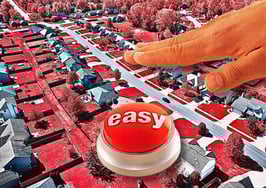

There’s a growing conversation in real estate that, on the surface, sounds efficient, modern and even appealing to today’s consumer. What if buyers and sellers could use AI for most of the process and simply hire a licensed real estate professional for specific tasks — hourly, on demand and only when needed?
- Need help pricing a home? Hire someone for that.
- Need assistance with a contract? Pay for a few hours.
- Need negotiation support? Bring in a professional temporarily.
It’s being positioned as flexible, streamlined and cost-effective. But beneath that idea is a much bigger question — one that should give our industry serious pause. Is this really the direction we want to go?
Because when you begin to break real estate down into individual tasks, you fundamentally change the role of the professional. This is no longer a relationship-driven business built on trust and guidance. It becomes a transactional, task-based model where the professional is no longer leading the process but instead reacting to it.
And in doing so, you don’t just change how agents are compensated — you change what they are responsible for, what they can stand behind and ultimately the level of protection the consumer receives.
‘Piecework’ is incompatible with fiduciary service
As licensed real estate professionals, we operate under fiduciary duty. That responsibility is not optional, and it is not situational. It requires us to provide fair, honest, and informed guidance, to act in the best interest of our clients and to stand behind the advice we give and the strategies we recommend.
But in a “piecework” model, that responsibility becomes blurred. A consumer gathers information — often from AI — and then hires a professional to execute a task based on that information.
What happens when that data is incomplete, outdated or simply inaccurate? Are we now asking licensed professionals to act on information they do not fully trust? Because that is where this model begins to break down.
The limitations of AI
AI is only as strong as the data it is built on and the way it is programmed. It can generate insights, identify patterns and provide general direction, but it cannot verify context in real time. It cannot walk through a home and recognize the nuances that impact value. It cannot understand the dynamics of a neighborhood, the influence of a nearby development or the subtle factors that affect buyer perception.
And yet, in a task-based model, the professional is no longer guiding the client through those complexities — they are simply being asked to perform a function within them.
After more than 20 years in this industry, I can say with confidence that most consumers do not fully understand the real estate process — and they shouldn’t be expected to. The average person buys or sells a home only a handful of times in their lifetime. It is not something they do regularly, and it is not something they are trained to navigate on their own.
That is why they seek out a professional. Not just to complete isolated tasks, but to guide them from beginning to end — to walk them through pricing, preparation, positioning, negotiation, and closing with clarity and confidence.
That guidance cannot be broken into pieces without losing its effectiveness. Walking a property room by room and offering suggestions on how to prepare it for sale is not a standalone task. It is connected to pricing strategy, marketing positioning and buyer perception.
Discussing decluttering, small updates or improvements is not just advice — it is part of a larger plan designed to maximize value and create the best possible outcome. These decisions build on one another, and when handled correctly, they create a seamless experience for the client. When handled in isolation, they become fragmented and disconnected.
A relationship built on trust
And then there is the most important piece of all — the relationship. Trust is not built in a one-hour consultation or a single task. It is built over time, through communication, consistency and showing up when it matters most. It is built by answering the phone when a client feels overwhelmed, by explaining the process when uncertainty sets in and by providing reassurance when emotions run high.
Because real estate is not just a financial transaction — it is a life event. It carries excitement, stress, uncertainty and, at times, deeply personal circumstances such as loss, relocation or major life transitions.
AI does not navigate those moments. It does not bring calm to a tense situation. It does not advocate, adjust or problem-solve when unexpected issues arise with a lender, a municipality, an inspection or a negotiation.
It does not tie together the loose ends that can derail a transaction if not handled properly. And it certainly does not build the kind of relationship that allows a client to feel confident, supported and understood throughout the process.
When you reduce the role of the real estate professional to a series of tasks, you remove that relationship. You remove the continuity, the accountability and the guidance that define the experience.
You replace it with a fragmented system where no one is truly responsible for the outcome and where the consumer is left to connect the dots on their own. That may appear efficient on paper, but real estate is not lived on paper. It is lived in real time, through real decisions, with real consequences.
This industry was never designed to function as a gig economy. It was built on expertise, trust and long-term relationships — on professionals who take ownership of the process and stand alongside their clients every step of the way.
And while technology will continue to evolve and should be embraced, we must be intentional about how we integrate it. Because there is a difference between using tools to enhance a profession and using them to dismantle it.
The future of real estate should not be about turning professionals into task-based workers. It should be about elevating professionals who combine expertise, experience and technology to deliver a higher level of service.
Because at the end of the day, consumers are not just hiring someone to complete a task. They are placing trust in someone to guide them through one of the most important decisions of their lives. And that is not a gig. That is a responsibility.
Lori Muller is the president of Fathom Realty in Cary, North Carolina. Connect with her on Facebook or LinkedIn.