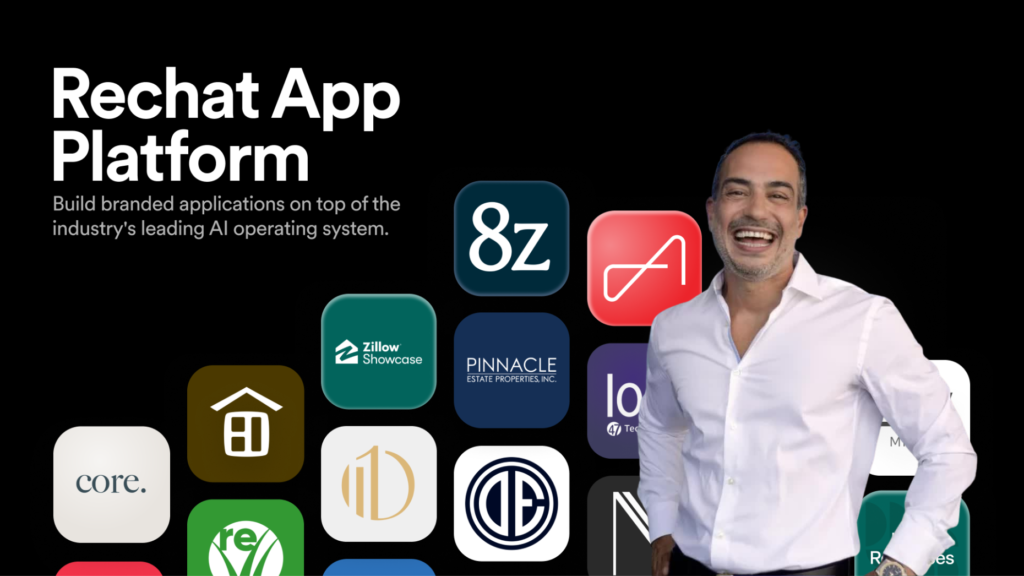

Rechat, the AI operating system behind Douglas Elliman and SERHANT., is opening its platform to outside developers, letting brokerages, tech partners and vendors build and launch their own branded apps on top of it.
The announcement lands at a moment when vibe coding and AI development tools have made building a custom app fast, but, as Rechat founder and CEO Shayan Hamidi sees it, have done almost nothing to solve the harder problem beneath the surface.
Build on it, not from scratch
By opening up its platform, Rechat says it bundles hundreds of third-party integrations, core brokerage systems, artificial intelligence and enterprise-grade security into a single platform, giving brokerages what they need to build and launch custom applications.

Shayan Hamidi
The company said that many brokerages want technology that feels like theirs, not off-the-shelf software. But building from scratch is expensive and outside most companies’ core competency.
Rechat’s open platform will enable any brokerage or partner to launch a branded application on Rechat’s infrastructure, without having to rebuild the underlying plumbing of a real estate business.
“That foundation is what lets a brokerage or a partnership create a production-grade app in weeks or months, not years. They build their idea; they don’t rebuild the infrastructure underneath it,” Emil Sedgh, Chief Technology Officer of Rechat, said in a statement.
Developers can now build custom interfaces that load directly inside Rechat. Each app lives on the developer’s own server and renders natively within the platform at runtime, with no bundling required.
Instead, it taps into what Rechat already provides: live data, such as the contact and user in view; actions, such as updating a record; and ready-made UI components, including an email composer, date pickers, and multistep forms.
Rechat said the result is an app that’s fast to build, lightweight, and visually indistinguishable from the rest of the platform. Once registered, it appears on the homepage and contact profile where agents already work.
The AWS for real estate
Hamidi said that about three years ago, they opened Rechat privately as a platform for this type of specialized app building. Large enterprise clients needed custom workflows and experiences specific to their business, things that didn’t make sense to build for everyone.
“So we introduced an app platform,” Hamidi told Inman. “You can create custom solutions on top of Rechat, build them yourself or get our help.”
Douglas Elliman was the first. They wanted to streamline their commission processing and reduce it from 18 days to a couple of hours. Rechat built that for them. Rechat also built custom solutions on top of their system for Porchlight and Nest Realty.
The challenge was that you still had to be a programmer, Hamidi said. Rechat made it as simple as they could, but not simple enough.
“Now take all of that and put it next to what’s happening in the world with AI,” he said. “The cost of creating software is going to zero. Anyone can build an app fast. That’s the big shift.”
But there’s a catch, he said: The application layer is becoming a commodity. What matters is what’s underneath, the foundation.
According to Hamidi, that’s exactly the gap vibe coding hasn’t solved: the distance between a cool prototype and a production-grade product — the security, compliance and data layers — all the sophistication an enterprise product requires.
“You can vibe code an app over a weekend,” Hamidi said. “You cannot take it to enterprise.”
That gap is what Rechat spent 10 years building. Hamidi said they have had this foundation in place, but the difference now is that people can build the software layer themselves, fast, on top of it.
“It’s the same thinking Jeff Bezos applied to AWS,” Hamidi said. “He’d built all this server infrastructure to run Amazon. Then he said: We’ve spent millions on this. Everyone else needs it. Why don’t we turn it into a service? That foundation enabled an entire generation of companies. Shopify did the same thing for e-commerce. That’s what we built for real estate.”
What brokerages are actually building
When asked what brokerages have built on top of Rechat so far, Hamidi said: “The heart of it is personalization.”
“For 20 years, the industry has pushed brokerages to adopt the tools available,” he said. “We’re moving into a world where the tools adopt what brokerages actually do.”
Hamidi said Ryan Serhant built a whole set of solutions for his brokerage on top of Rechat.
“He’s running a full-service brokerage and doesn’t want agents lifting a finger,” he said. “So he’s created experiences where agents can place orders, route requests to the back end and AI handles the rest — very custom to how his business works.”
Nest Realty is a different example. They’re built around relationship-based, high-touch marketing, such as gifts, personal outreach, things that don’t fit a normal CRM drip campaign.
“That’s been their edge for 10 years. Now it’s digitized and one-click for agents,” Hamidi said.
There’s also a longer-term shift worth paying attention to. Hamidi said the fastest-growing segment of software users isn’t humans — it’s AI agents.
“The products brokers build today will increasingly be used by AI tools doing the work autonomously,” he said. “That makes the foundation conversation even more important, because the foundation is what gives an AI agent the access controls and guardrails to operate safely. The most important UI in the next few years probably isn’t a screen — it’s the API.”
The guardrails are already built in
Hamidi added that building on Rechat’s foundation also removes some of the inherent cybersecurity risks of vibe coding.
“If I build a website that charges people money and I’m not using Stripe or a similar foundation for payment processing, there’s a good chance I get hacked,” he said. “I can vibe code that product over a weekend and charge thousands of dollars through it — and it’ll be secure — because the payment processing piece runs on a secure foundation. I didn’t have to build that part.”
The same principle applies to what Rechat is doing, he said.
“Everything within Rechat has provisions. Our AI agent, Lucy, can do a lot of work inside the platform, but there’s no way to get her to access another agent’s data,” Hamidi said. “She has access controls. We’ve also layered in MLS zoning rules, fair housing rules, association rules — things an out-of-the-box model has never been trained on. That’s why people get in trouble when they just point a general AI at real estate problems.”
From buyer to builder
Hamidi said Rechat decided to open up its platform for this use now because enterprise clients who’ve used it so far have paid a significant amount to do so.
“Engineering was required, and we’d often build it with them. Now, anyone can build it themselves,” he said. “There’s a whole movement around brokerages wanting to build their own tools, but they keep hitting a wall when it comes to shipping.”
Now, Rechat is giving them a sandbox where they can build quickly and then actually launch. Distribution is built in and, if you’re a broker with 1,500 agents, Hamidi said you don’t have to deal with hosting, onboarding or rollout.
“You turn it on, and it’s live across your entire roster,” Hamidi said. “That would take months otherwise.”
According to Hamidi, the real estate industry is moving from being a buyer of software to being a builder of software.
“We want to enable that transition so they can build fast, build safely and build on a foundation that can actually support it,” he said.
Much of this process, he said, is made possible by advancements in AI.
“Was it possible to go from New York to Paris 100 years ago? Yes, but it was expensive, and very few people did it. Now you do it for a long weekend. AI did that for software creation,” he said.
But here’s what keeps happening, he said: someone vibe codes their way to 80 percent of a project in a month, and then the last 20 percent — the foundational integration work — takes over a year.
“I heard that exact story at an event a couple of weeks ago,” Hamidi said. “That’s the gap. And that’s what we’re solving.”