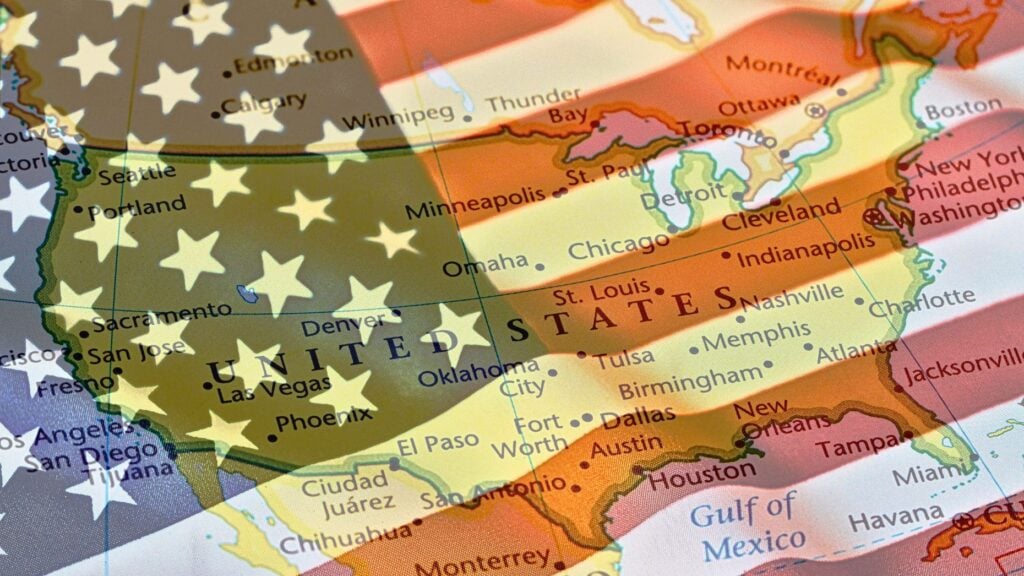

“Under all is the land.” For more than a century, those words have appeared in the preamble to the Realtor Code of Ethics. As America approaches its 250th birthday, they’re worth revisiting.
Because before there were listings, mortgages, title companies, brokerages or Realtors, there was land. And before there was a real estate industry, there was a question that would shape the next two and a half centuries of American history:
Who owns it?
1776 — Certain Unalienable Rights
Not surprisingly, many of the Founding Fathers were substantial landowners. In much of early America, you often couldn’t vote unless you owned property. George Washington certainly qualified, accumulating more than 70,000 acres during his lifetime. For many of the founders, land ownership wasn’t simply wealth. It was influence, independence and political power.
The generations that came before us didn’t just assemble the map. They established the boundaries, ownership rights and legal framework that allowed land to be bought, sold, inherited, financed and transferred from one generation to the next.
Some land was purchased. Some were annexed. Some changed hands through treaties following war. Much of it was already inhabited and governed by Native nations long before any of those transactions took place.
This isn’t a clean real estate story, and it wasn’t easy. There were mistakes, regrets and omissions. Realtors today will tell you that’s how most every real estate deal still is.
If you’ve seen Hamilton (my daughters had it on loop for months) or your history class, you’ll remember the debates between Jefferson and Hamilton over the future of the young nation. Jefferson envisioned an agrarian republic built on landownership and homesteads. Hamilton envisioned a commercial power connected by trade, ports, railroads and industry.
America was fortunate enough to become both.
The real estate deals that followed helped make that possible.
1803 — The deal that doubled America
The Louisiana Purchase cost the United States $15 million. Adjusted for inflation, that’s over $400 million today. But for roughly the cost of an active five-bedroom, four-bath, 8,000-square-foot luxury ranch currently listed in Louisiana, the United States doubled in size.
Jefferson acquired approximately 530 million acres from France, who needed to cash out, securing control of the Mississippi River and the port of New Orleans.
Access to trade routes has always mattered. Whether it’s the Mississippi in 1803 or the Strait of Hormuz today, nations tend to pay attention when commerce stops flowing through a narrow choke point controlled by someone else.
Looking back nearly 250 years later, it’s difficult to find another transaction that reshaped the future of a nation so dramatically.
Unless, that is, you talk with someone from Texas.
1845 — Everything is bigger in Texas
Unlike Louisiana, Texas was not purchased.
After nearly a decade as an independent republic, Texas joined the United States through annexation in 1845.
Texas wasn’t simply about acquiring more land and the stars at night that are big and bright. It was about security, growth and strategic depth. At one point, Texas claimed territory extending into parts of present-day Colorado, Wyoming, Kansas, Montana and Oklahoma.
That’s truly bigger.
1848 — Buying the best coast
Three years later, the United States acquired California and access to the Pacific.
The Treaty of Guadalupe Hidalgo is nearly identical to the Louisiana Purchase and roughly the price of a waterfront Malibu estate today.
The United States wasn’t buying it for the chill vibes, warm sunsets and accessible surfboard flow yoga. Access to the Pacific was access to an entirely new economic future.
Then came an unexpected bonus.
Less than two weeks before the treaty was signed, gold was discovered at Sutter’s Mill in California. Apparently, gold didn’t show up on the pre-cession inspection.
1853 — Location, location, location
The Gadsden Purchase. Huh … yeah.
Truthfully, I completely forgot about the Gadsden Purchase. Actually, I’m not sure I ever learned about it. Perhaps I was sick that day.
Anywho, it added another 30 million square miles, largely to secure a viable southern route for the transcontinental railroad. Infrastructure drove the decision then, as it does now.
Location. Some things never change, even if you’ve never heard of it.
1867 — Seward’s Folly
If Louisiana was the greatest real estate bargain in American history, Alaska may be the runner-up.
For $7.2 million, or roughly 2 cents per acre, the United States acquired approximately 375 million acres from Russia. At 2.5 times larger than Texas, for half the price, critics still mocked the deal as “Seward’s Folly.”
History has been considerably kinder.
The purchase included immense natural resource wealth and strategic access to both the Arctic and Pacific. Alaska later proved its military value during World War II, when Japanese forces occupied portions of the Aleutian Islands and forced the United States to fight on its own soil to reclaim them. (Fellow history nerds, The Thousand-Mile War is a solid read.)
So valuable is the land, in fact, that eligible Alaska residents still receive annual dividends funded by the state’s natural resource revenues.
Not bad for a deal signed in 1867.
1898 — Aloha, America
Officially, Hawaii entered the United States through annexation in 1898. The reality was considerably more complicated, involving commercial interests, military strategy and the overthrow of the Hawaiian monarchy.
By then, the Pacific was no longer a frontier. It was an ocean highway for commerce. So, the underlying motivation was familiar: trade, security and access to emerging markets.
The map was assembled
By the end of the 19th century, the map we recognize today was largely in place. Check out this pre-1900 map for reference.
The country had expanded from 13 colonies to a continental nation stretching from ocean to ocean. It had also achieved something few nations in history ever have … an ocean-sized moat on either side.
Looking back, the motivations of those generations were surprisingly familiar. Safety and security, space, resources and access to markets. The same type of forces that shape real estate decisions today were shaping national ones 250 years ago and throughout our history.
That’s the version of the story most of us learned in school (other than the Gadsden purchase). What receives far less attention is what happened after the land entered the United States.
Because acquiring the land was only the beginning. The story of who ended up owning it is where things get really interesting.
That’s where the story goes next.
Read Part 2 of this 2-part series: “Who ended up owning America?“
Chris Drayer is co-founder of Revaluate, which segments consumers for marketers by propensity to move.