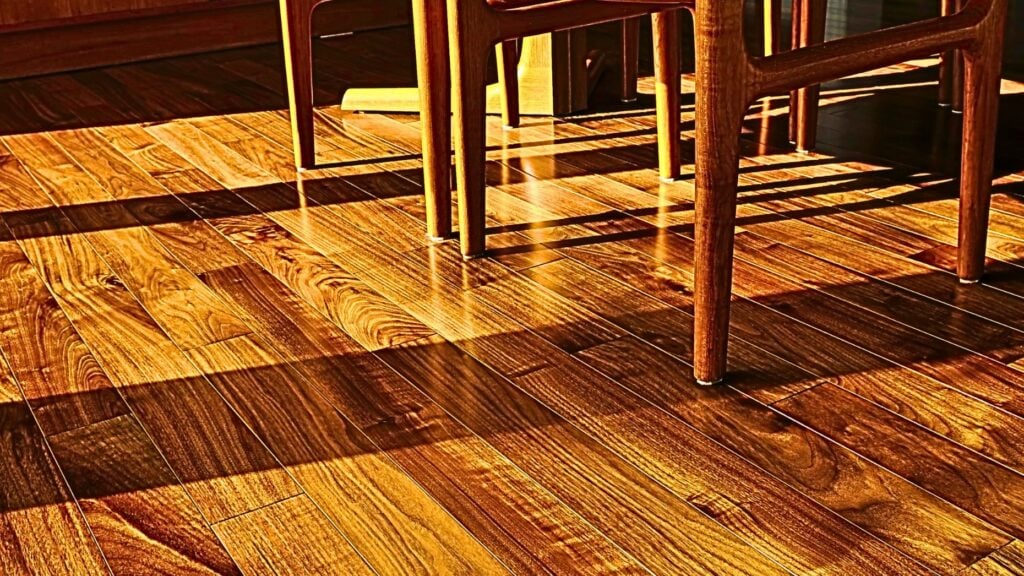
Sooner or later, the seller looks up from the hardwood floor and asks what it’s going to cost. Whatever number comes out of your mouth in the next ten seconds is the number they plan around, even if you hedged it three times.
I refinish hardwood around metro Atlanta, and I list homes as a licensed agent, so I get that question from both chairs. Here is how I walk a seller from “These floors are shot” to a real budget in about 10 minutes, without pretending I’ve done an inspection I haven’t.
Start with square footage, not price
Every flooring number is a per-foot number, so the conversation goes nowhere until you know the area. Not the whole house. Just the wood. Pace it off room by room if you have to.
Say “about 1,400 square feet of oak on the main floor” out loud and watch what happens. The seller stops treating the floors as one big scary blob and starts doing the math with you. That is most of the battle right there.
Count the stairs while you’re at it. Stairs get priced per step, not by the foot, and I have watched 15 of them add $900 to a quote a seller thought was already settled. Nobody ever remembers the stairs.
Price the refinish first, because it’s the floor of the conversation
Refinishing is almost always the lower number, so lead with it. It gives the seller a baseline, and it keeps the panic down.
In metro Atlanta, I’m quoting refinishing in the neighborhood of $4.50 a square foot right now, sanded, stained and sealed, furniture moved, debris hauled. On that 1,400-foot main floor, that’s roughly $6,000 or $7,000 with the stairs in.
Your local number will differ, and it should. Get a real one from somebody who works in your market, and keep it in your head, because a rough right answer delivered on the spot beats a precise one delivered next Tuesday.
Now price the replacement honestly, all four pieces
This is where most estimates go wrong, because people quote the new wood and forget the rest. A replacement is four line items, not one.
You are paying to tear out the old floor. You are paying for the new material. You are paying to install and finish it. And you are paying to haul away everything you ripped up.
Add those together and, in my experience, replacement lands around two and a half times the cost of refinishing the floor that’s already there. On that same main floor, a refinish I’d quote around $7,000 becomes something closer to $18,000 once you stack demo, material, installation and a dumpster. Same room. Same finished look to most buyers.
Say the middle option out loud
Almost no seller knows this one exists, and it’s the cheapest honest answer I’ve got.
If the finish is just tired but the wood underneath is dry and solid, you can screen and recoat: scuff the existing finish and roll a fresh coat over it, no full sand. It runs a fraction of a refinish, and it photographs beautifully.
It will not pull out deep scratches, and it will not change the color, so it is not a fix for a damaged floor. But for a floor that has only lost its shine before a listing, it is often the entire answer.
Count the costs that never make it onto an estimate
Dollars are only half the decision, and the half sellers underweight.
A refinish is typically a two- or three-day job. A tear-out and replace takes a week or more, and during that time, the house is unlistable and unlivable in the affected rooms, and there is a dumpster in the driveway.
For a seller trying to hit a listing date, those days are real money. I have watched a two-week floor project push a listing past the weekend everybody was aiming for, and that delay cost more than the flooring difference did.
When replacement actually wins
I am not against replacement. I install new floors. There are cases where it is plainly the right call, and you should be able to name them.
The wear layer is gone, and there is nothing left to sand. This is most common with engineered flooring, where the real wood on top can be too thin to sand even once. Water or termites have gotten into the boards or the subfloor. Or the seller wants something the existing floor cannot become: a different species, a wider plank, a completely different look.
Outside of those, refinishing usually wins on both the dollars and the calendar.
What to actually say
You do not need to quote the job. You need to keep the seller from budgeting off a guess. Something like:
“Before you plan on new floors, let’s get a refinishing number. In most houses it comes in well under half of replacement, and it’s a few days instead of a few weeks. If the wood turns out to be too far gone, we’ll know quickly, and we’ll go the other direction.”
That sentence has saved sellers I work with real money, and it has saved agents from pricing a listing around a tear-out that never needed to happen.
 Money Matters Month is here. All September, Inman is focused on the financial side of real estate — the part nobody teaches you when you get your license. How to budget through lean times, protect your profits when business is good and find new ways to grow your bottom line no matter what the market is doing.
Alex Veit refinishes hardwood floors and sells houses in metro Atlanta. Get connected on Instagram or at Oakerds.