

Homeownership is slipping further out of reach for young Americans, according to the National Association of Realtors’ 2026 Profile of Home Buyers and Sellers.
The report, released on Thursday, revealed that the share of first-time homebuyers rose 1 percent year over year to 22 percent. Despite the small gain, first-time buyer activity remains near historic lows (21 percent) and 18 percentage points below pre-2008 trends (40 percent). Same as last year, the median age of a first-time homebuyer was 40 — roughly a decade older than the typical median age in the 1980s.
NAR said student loans, consumer debt, and rising living costs are delaying key milestones for younger Americans, leaving them to wait on a generational wealth transfer to make their homeownership goals happen. However, that transfer is coming at a slower pace as older Americans live and work longer.

Jessica Lautz
“Affordability remains the biggest hurdle for first-time buyers,” said Jessica Lautz, NAR deputy chief economist and vice president of research, in a written statement. “The share of first-time buyers is still about half the historical norm of 40 percent seen before 2008, and those saving on their own continue to face high rent, student debt, and a shortage of homes they can afford.”
“The housing market is beginning to see a generational transfer of wealth. It’s not yet a tsunami, but it is changing who can buy a first home and when,” she added.
The difference an inheritance makes
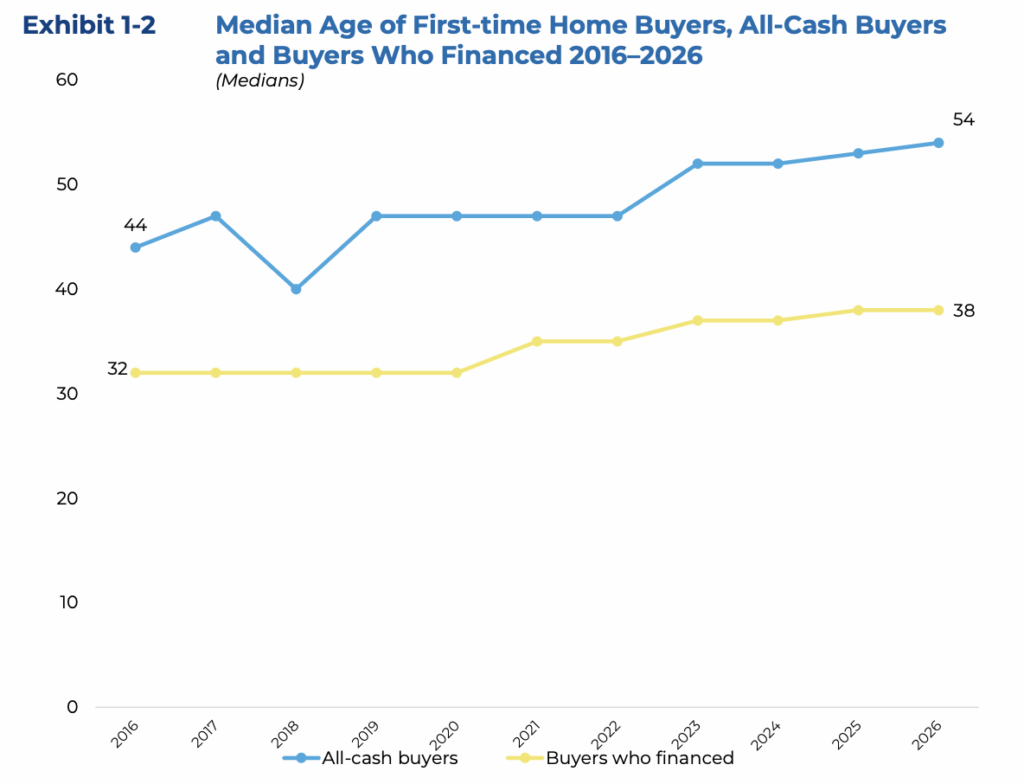
Although the wealth transfer is more of a wave than a tsunami, NAR found that more first-time homebuyers are funding their purchases with an inheritance, driving the share of all-cash transactions among this cohort to an all-time high of 10 percent. However, all-cash first-time homebuyers are significantly older than their counterparts who financed their purchase, with a median age of 54 versus 38.
“There has been fodder in the housing industry about the “silver tsunami” and the impact of older generations passing their wealth to the next generation and the influence into the housing market,” the report read. “Increasingly, this is appearing in the data. This year, 10 percent of first-time buyers were all-cash buyers, an all-time high … Among those who financed, the reasons are apparent: housing affordability, the dearth of inventory, high rent, student debt, and in recent years inflation.”
“Among all-cash home buyers, they are [impacted] by all of the above factors, but also are also waiting longer perhaps for a transfer of wealth or waiting to make an all-cash purchase using financial assets and savings,” it added. “What is clear is that life expectancy has grown, and as older Americans pass their wealth to the next generation, this generation is no longer young adults anticipating a wealth transfer but rather has hit middle age.”
Credit: NAR
For buyers who financed their purchases, inheritances are allowing larger down payments. The lion’s share of down payments still comes from personal savings (62 percent), financial assets like 401(k) savings, stocks or cryptocurrency (30 percent) and gifts or loans from family and friends (25 percent). However, the share of homebuyers who used an inheritance reached 10 percent — the highest level since NAR started publishing its Profile of Home Buyers and Sellers in 1981.
Like all-cash purchases, the median age of homebuyers with the largest down payments skews older.
Homebuyers who make down payments of 20 percent or more have a median age of 40. Those with down payments between 11 and 20 percent have a median age of 36, while homebuyers who make the smallest down payments of 1 percent to 10 percent have a median age of 38. The median age of each group is higher than it was 10 years ago (33 and 32, respectively).
“As buyers have more reliance on both financial assets and inheritances, which allow all cash purchases and purchases with large down payments, these buyers wait for a longer period of time to purchase a home,” the report read. “For home buyers with the smallest down payments, they must save for a longer period of time to enter homeownership. Those with moderate down payments had smaller increases in age over a decade.”
The shift in household dynamics — and an increase in unmarried roommates
Weakening affordability isn’t only impacting the way that Americans are funding their purchases — it’s also changing household dynamics.
The share of homebuyers who purchased a multigenerational home remained steady at 14 percent, with the greatest reasons including taking care of aging parents (30 percent), cost savings (23 percent), children over the age of 18 never leaving home (19 percent), and children over the age of 18 moving back home (18 percent).
Buyers also said multigenerational housing let them spend more time with aging parents (18 percent) and afford a bigger home than they would as individuals (11 percent).
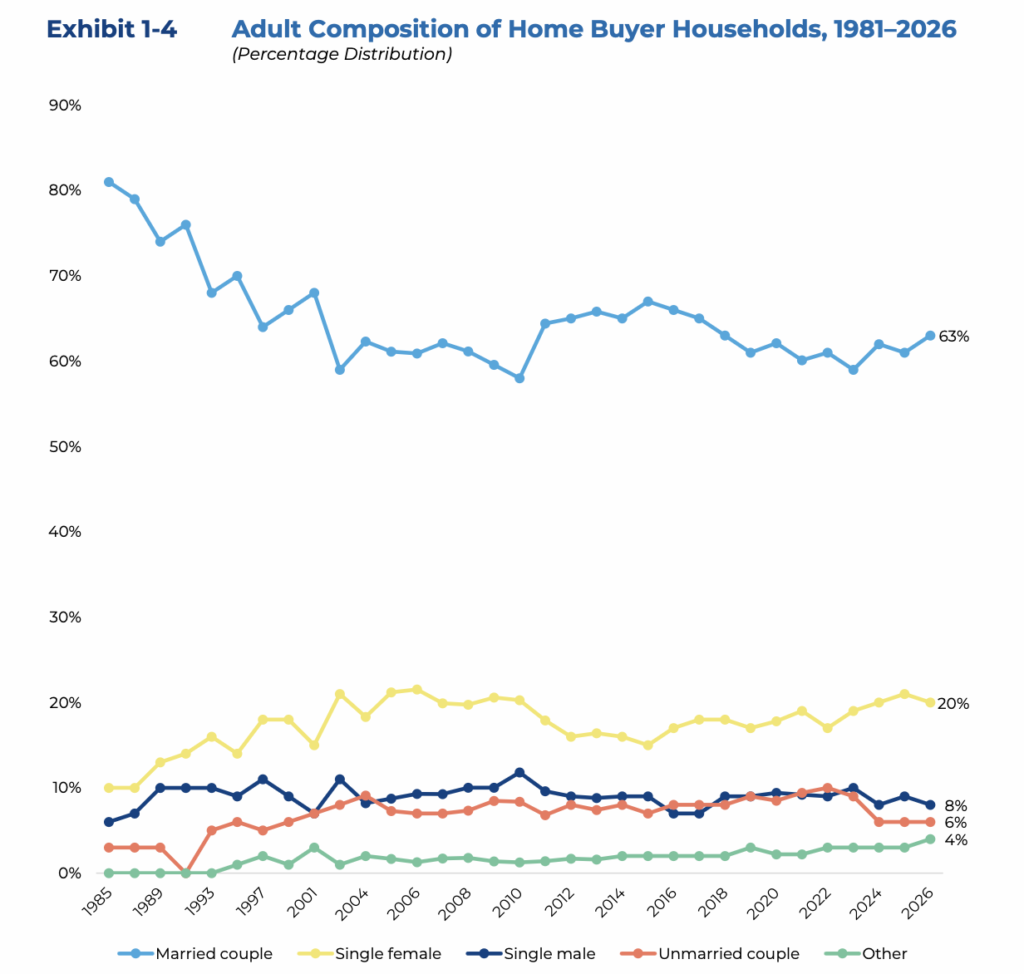
Married couples continued to dominate the market, accounting for 63 percent of all homebuyers. The share of unmarried couples remained unchanged from 2025 at 6 percent, while the share of single women (20 percent) and single men (8 percent) who purchased a home in the past year declined by a few percentage points. However, another group — non-romantic roommates — increased their market activity to four percent, an all-time high.
Among first-time homebuyers, single men (12 percent) and non-romantic roommates (5 percent) tallied the largest gains, while the share of single women remained unchanged at 25 percent and the share of married couples dropped to an all-time low of 47 percent.
Credit: NAR
NAR said the increase in home purchases among non-romantic roommates reflects the affordability challenge.
Married couples — whether they’re first-time or repeat homebuyers — have the highest household median income of $138,000. Unmarried couples are second at $117,000, followed by single males ($91,000) and single females ($76,000). Non-romantic roommates have a median household income of $93,000, which is higher than single males and females.
“As marriage rates decline and housing affordability remains arduous for first-time buyers, creative solutions to enter homeownership, such as roommates, have increased,” the report read. “Purchasing as a roommate can assist with housing affordability and companionship.”
Market challenges increase agent value
Despite homebuyers having more information at their fingertips than ever, NAR found that the majority of homebuyers still rely on agents and brokers to navigate the market.
Ninety percent of homebuyers purchased their home with an agent or broker, with the greatest value coming from an agent’s ability to help them find the right home (51 percent), negotiate the terms of the sale (15 percent), negotiate the price (12 percent), handle paperwork (7 percent), understand affordability (4 percent) and navigate financing (2 percent).
As for how homebuyers found their agent, 40 percent overall found them through a friend, neighbor or relative. When comparing first-time and repeat homebuyers, first-timers were more likely to rely on a referral (52 percent) than repeat buyers (39 percent). However, that’s likely because 24 percent of repeat buyers re-hired the agent they worked with for a previous purchase.
Despite the embrace of artificial intelligence in other facets of life, only one percent of homebuyers found their agent or broker using AI — a statistic that Lautz said underscores the enduring importance of personal relationships.
“More buyers and sellers are using agents than ever before,” Lautz said. “This might seem counterintuitive given consumers have access to more information than ever before. However, all that information can be misleading without proper context. When executing one of the largest financial transactions of most people’s lives, consumers need localized expertise from agents to give buyers and sellers personalized knowledge.”