As the war in Iran stretched into its fourth month, signs emerged that the Strait of Hormuz might eventually reopen.
Investors celebrated. Oil prices dropped. But most real estate agents surveyed by Intel have yet to see any improvement in their business prospects, results from June suggest.
Even though agents in recent weeks have become a bit more optimistic they’ll find new homebuyer clients in the year ahead, they remain stuck for now in buyer and seller purgatory, according to the most recent Inman Intel Index survey.
And their overall outlook has not improved much even as financial markets have reacted positively to recent developments in the negotiations to reopen the crucial trade chokepoint in the Middle East.
Client Pipeline Tracker score in June: +0.5
- Previous high point: +13.0 in January
- 12 months ago: –2.0 in June 2025
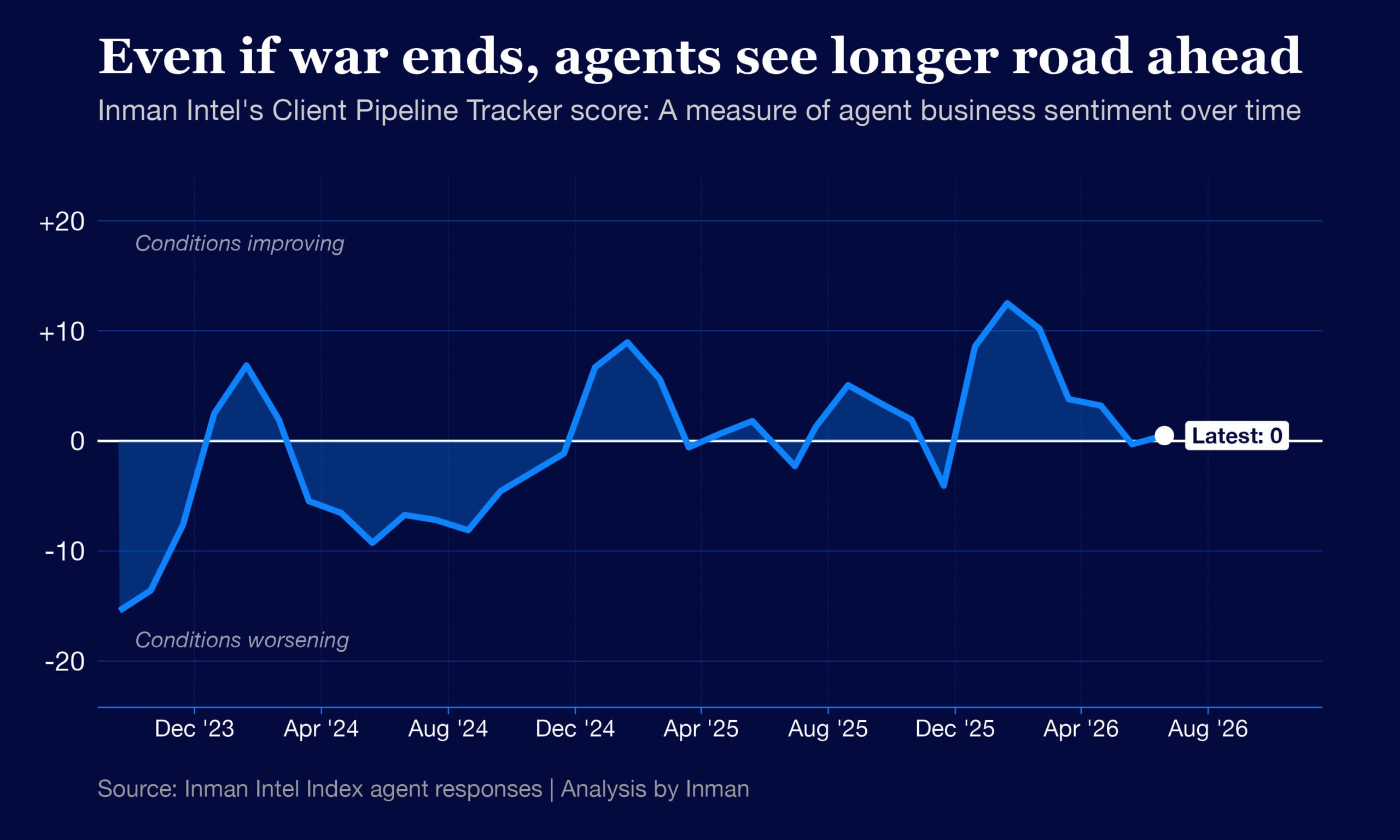
Chart by Daniel Houston
Business sentiment among agents has swung wildly since last fall, and those whom Intel surveyed were still in the process of recalibrating expectations for the year ahead.
Read the full breakdown of the score’s four components in this week’s report.
In a holding pattern
Intel’s Client Pipeline Tracker is a compilation of how agents feel about their buyer and seller pipelines — both over the past year and in the near future.
Intel described the methodology in this post, but here’s a quick refresher on how to interpret the scores.
- A score of 0 represents a neutral period in which client pipelines are neither improving nor worsening.
- A positive score reflects a market in which client pipelines have been improving, or are widely expected to improve in the next 12 months. The higher the rating, the more confident agents are that conditions are moving in a positive direction.
- A negative score suggests client pipeline conditions are worsening, or are widely expected to get worse in the year to come.
A significantly positive combined score falls around the +20 mark. This type of score would signify that much of the industry is in agreement that pipelines are improving and will continue to improve.
A significantly negative combined score, on the other hand, falls closer to -20. That’s a bit lower than where the industry stood in September 2023, the first time Intel surveyed agents about their pipelines.
For each of the four individual components that go into the score, results as high as +50 or as low as -50 are sometimes observed.
Here are the component scores from the most recent survey, and how each sentiment category changed from the previous one.
Tracker component scores
May → June
- Present buyer pipelines: -19 → -20
- Future buyer pipelines: +3 → +8
- Present seller pipelines: -5 → -6
- Future seller pipelines: +8 → +7
The most noticeable shift over the past month — and the one that drove the composite Client Pipeline Tracker rating a bit higher — was in future expectations for buyer pipelines.
- The share of agent respondents who said they expected their buyer pipelines to be heavier a year from now was 32 percent in June, up from 27 percent the month before.
- Still, that share was well below the 51 percent of agent respondents who had predicted year-over-year pipeline growth back in January.
The monthly improvement in forward-looking buyer sentiment was partly offset by the fact that agents didn’t feel the same way about their future seller pipelines.
It’s also clear that while some agents are keeping hope alive for a better year, it’s not because they’re seeing dramatic improvements in their buyer and seller pipelines heading into the summer closing rush.
- The share of agent respondents who told Intel their buyer pipelines were lighter than at this time last year was virtually unchanged from May to June.
- However, agents reporting “significant” slippage in buyer pipelines, instead of moderate reductions, grew from 14 percent of all respondents to 18 percent in that time.
On the seller side, some similar movement was observed, with slightly fewer agents reporting big year-over-year gains in listing clients and slightly more reporting big losses.
As a result, agent sentiment toward listing pipelines dipped slightly for the fifth consecutive month.
Oil’s cheaper, but not mortgages. What gives?
This movement is happening against the backdrop of continued volatility in financial markets — and, by extension, mortgage rates.
As negotiators attempted to make progress on a deal to end the war between the U.S. and Iran, hopes that the crucial shipping chokepoint at the Strait of Hormuz might soon reopen have driven oil futures back down.
- When Intel’s May survey closed, crude oil futures were trading at prices 33 percent higher than their pre-war levels.
- By the time the Inman community began to take the most recent survey, crude oil futures had fallen to only 11 percent above pre-war prices.
But while falling gas prices have given consumers some measure of relief at the pump, they haven’t necessarily seen the same with mortgage rates.
Federal Reserve officials have been closely watching the latest inflation data, which has prompted them to signal that they might be reluctant to continue cutting rates until the present bout of inflation subsides.
This same uncertainty has caused bond markets and their closely linked mortgage rates to mostly tread water as well.
- Fixed rates for a 30-year mortgage were roughly at the same level — just above 6.5 percent — during the June survey as they were the month before, even as homebuyers weathered jagged ups and downs from day to day.
For these reasons, the real estate industry appears stuck in much the same place it’s been for the past few months, even as other corners of financial markets have begun to react with relief to developments in the Middle East.
Intel will continue to track these factors — and their effect on reported client pipelines — in the months ahead.
Methodology notes: This month’s Inman Intel Index survey ran from June 16-25, and had received 457 responses as of Wednesday. These results are preliminary and may be revised. The entire Inman reader community was invited to participate, and a rotating, randomized selection of community members was prompted to participate by email. Users responded to a series of questions related to their self-identified corner of the real estate industry — including real estate agents, brokerage leaders, lenders and proptech entrepreneurs. Results reflect the opinions of the engaged Inman community, which may not always match those of the broader real estate industry. This survey is conducted monthly.