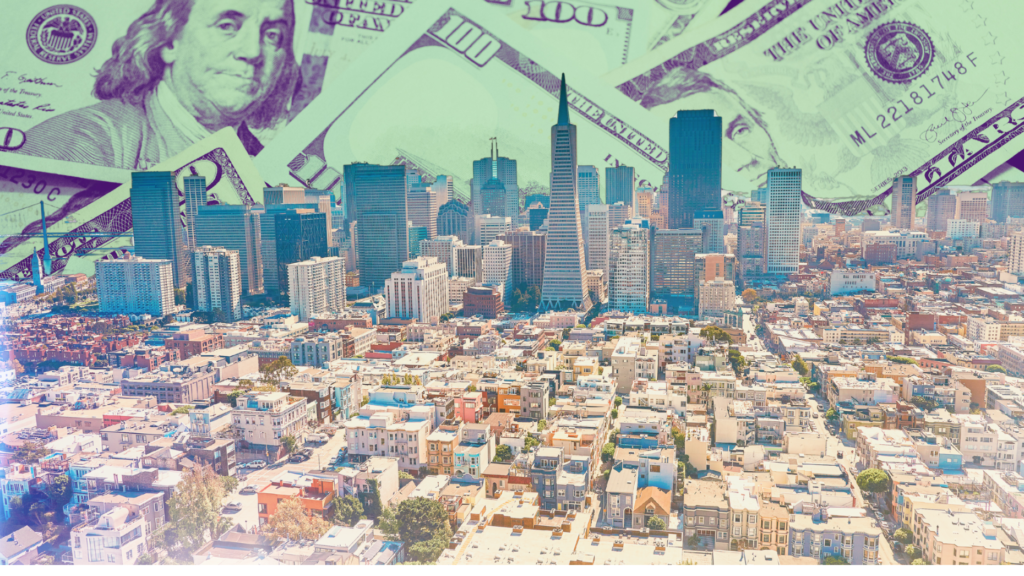

Current and former employees of OpenAI and Anthropic could hypothetically pool their IPO winnings and buy 29 percent of every home in the San Francisco metro area. Not just what’s listed for sale, but the entire housing stock, according to a new Redfin analysis published July 9.
The number is illustrative, not a forecast. Neither company has priced or scheduled an IPO, and Redfin’s own researchers caveat that the calculation is “purely hypothetical and not a realistic representation of where IPO proceeds will go.”
But the scale is the point. Two companies headquartered in one metro area could, on paper, absorb nearly a third of its housing stock in a single liquidity event.
2 companies, one hypothetical shopping spree
Redfin’s report calculations start with valuation.
OpenAI is reportedly targeting a valuation above $1 trillion in late 2026 or 2027, and its employee equity stake is unusually well documented. Roughly $80 billion is already vested plus a $50 billion stock grant pool, putting employee ownership at about 26 percent of the company.
After broad tax assumptions, Redfin estimates that nets out to $135 billion in after-tax proceeds. Set against San Francisco’s $692 billion in total home value as of 2024, that’s enough to buy 20 percent of the metro outright.
Anthropic’s stake is murkier. The company confidentially filed its S-1 on June 1 at a reported valuation of $965 billion to $1 trillion, but its employee equity isn’t publicly disclosed.
Redfin modeled it by backing out known institutional holders and applying typical employee-ownership ranges from comparable late-stage tech IPOs, landing on a $120 billion midpoint, or $63 billion after tax. That’s enough for Anthropic employees alone to buy 9 percent of San Francisco.
Combined, that’s 29 percent. The same modeling method applied to San Jose and Oakland shows similar concentration. A separate Redfin report pegs SpaceX’s hypothetical Starbase-area buying power at 40 percent of San Antonio’s housing stock.
The caveats are worth noting. Lockup periods can run up to 180 days after an IPO; tax treatment varies by state and stock type; and Redfin’s Anthropic figure, in particular, is a model, not a disclosed number. The actual employee stake could land well outside that 10-to-15-percent range.
The SF market isn’t waiting for the IPOs
None of this is theoretical for the market that’s already absorbing it.
San Francisco home prices are climbing at their fastest pace in nearly a decade, and the artificial intelligence industry’s compensation — not its equity, its cash comp — is doing most of that work before either IPO happens.
Compass International Holdings’ July market report, authored by Chief Economist Mike Simonsen and Bay Area analyst Janel Evans-Anderson, shows just how tight the supply side has gotten.
The median single-family home price in San Francisco County rose 24.8 percent year over year in June to $2,128,000. Active listings ended the month at 590 — the tightest summer inventory level since 2020 — against 546 properties under contract.
“This equates to an absorption rate of approximately 92 percent, meaning nearly as many homes were pending sale as were actively available,” Simonsen said. “Put another way, the market had just over one month of inventory, an exceptionally tight level of supply for this time of year.”
It’s not just home prices
The cost side of the ledger backs up what real estate agents are already telling clients.
BLS data for the San Francisco-Oakland-Hayward area shows the Consumer Price Index up 3.8 percent for the 12 months ending in June, with shelter costs specifically up 3.3 percent over the year and 0.5 percent in the two-month period alone.
Energy prices are up 12.9 percent annually, driven by a 20.7 percent jump in gasoline costs. It’s the kind of overhead that compounds against a household already stretching for a seven-figure mortgage.
Regional Commissioner Chris Rosenlund noted core inflation — all items less food and energy — rose 0.2 percent for the period, with new and used vehicle prices and shelter pushing the index up even as apparel and household furnishings pulled it down.
What this means for agents
For real estate agents working the luxury and move-up segments in San Francisco, San Jose and Oakland, the practical read isn’t “wait for the IPOs.”
It’s that AI-sector cash compensation is already inflating the top of the market well ahead of any liquidity event. And inventory is tight enough that even a fraction of the hypothetical IPO windfall Redfin describes would meaningfully move pricing in specific neighborhoods and price bands.
Redfin’s own analysis frames this correctly. The wealth being created is real and enormous, even if the buying spree it describes never happens exactly as modeled. Two IPOs, a tight summer market and inflation running hot on shelter costs are converging in San Francisco.