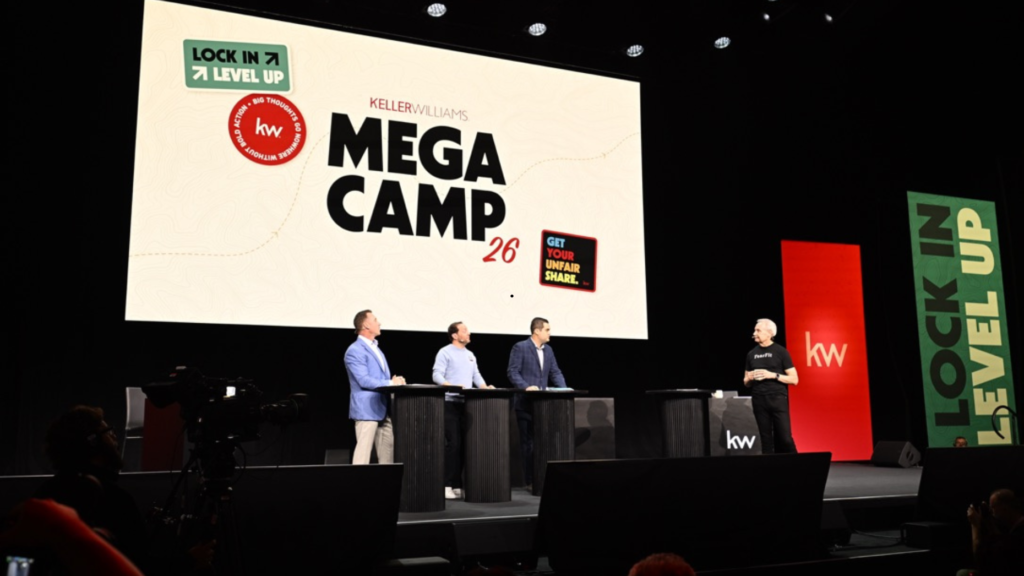

Gary Keller wishes he had better news about the housing market.
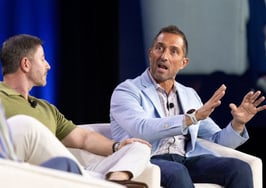
Keller and his panelists — KW Chief Economist Ruben Gonzalez, Chief Industry & Strategy Officer Jason Abrams and VP of Maps Coaching Cody Gibson — spent the first 30 minutes of the Texas franchisor’s annual Mega Camp delivering a dour update about the economy, with unemployment, inflation and mortgage rates at the source of consumers’ uncertainty.
“I don’t know that this is going to be fun for you,” Keller said. “It was very painful for us.”
The panel ripped the Band-Aid off by diving into the employment situation. The numbers, Keller said, look fine on paper, with the unemployment rate at 4.1 percent — nowhere near the tentative six percent benchmark that signals a potential recession. However, Keller and Gonzalez said a deeper dive into employment numbers is a canary in the coal mine, with weak monthly job growth and workforce participation showing an economy on the brink.

Gary Keller
“We’ve had, essentially, a slowdown in the growth of the labor force. We’re actually adding fewer jobs. In fact, we lost jobs in July,” Gonzalez said. “But we’re not adding people into the group that’s looking for jobs either. So, essentially, we’re in this kind of like low-hire, low-fire [environment].”
The latest Bureau of Labor Statistics report revealed the country lost 23,000 jobs in July, and also downgraded May and June’s payroll growth by a combined 103,000 jobs. That revision knocked the three-month average of payroll growth down to 20,000 jobs per month. The number of discouraged workers — those who lost their job and believed there were no jobs for them — was unchanged at 476,000.
Gonzalez said a healthy market would have around 200,000 job additions. However, massive layoffs in the federal government and the financial sectors mean the job market is being buoyed by just a couple of industries. Healthcare is the strongest, the economist said, but even growth in that area is waning, dropping in July from an average of 36,000 per month to 22,000.
“Everyone’s feeling that it feels a little bit more flat. It feels a little bit more stuck,” he said. “You know, you have a job, but you couldn’t necessarily change your job. It’s harder to go negotiate for more money. That’s kind of where we are.”
Weak wage growth, which was 3.1 percent in July, has made it more difficult for consumers to handle rising inflation. The Fed’s inflation target is 2 percent; however, the latest report put the Consumer Price Index (CPI) at 3.4 percent. The Core CPI, excluding food and energy, is closer to the target, at 2 percent. Overall, monthly consumer prices rose 0.1 percent from June to July.
“Wages are keeping up with inflation and not much more than that … And all of that adds up to a period of discontent, right?” Keller said. “The effect really depends on where you are, what income level you live at. If you’re on the lower side of income earning, this all really matters. This is a big deal, right? Five thousand a year makes a big difference to someone who’s making 40, 50 or 60 thousand.”
“And it’s not as big of a deal for someone who’s making 100, 150, or 200 thousand. So you have two different experiences going on in America right now, right?” he added. “I always wonder why the people who make the most money get to make the decisions for the people who make the least money.”
Keller said the economy was primed for a rebound in 2025, until the Trump Administration started creating uncertainty with tariffs and the conflict in Iran.
“Never underestimate the willingness of the government, when things are good, to make them bad. By the way, that’s not political. That happens on both sides of the aisle,” he said. “I’m just saying that when things are really good and a new administration comes into power, they immediately believe that they have wiggle room to go and run policy, right? That they’ve been just waiting to put into place, and that’s all well and good.”
“If you’re elected, you were elected on certain issues, right?” he added. “But you have to pay attention to the economy because it’s all about the economy, stupid. It’s all about jobs and what things cost.”
The panel said the Fed is unlikely to drop the federal funds rate (i.e., the short-term rate), which doesn’t bode well for mortgage rates and, in turn, affordability. As fall homebuying inches closer, Gibson said it’s important for agents to help their clients avoid one thing: attempting to time the market.
“You’re never buying at the top of the market,” Gibson said. “You’re just buying at the top of the moment.”
Gibson and Abrams explained the ebb and flow of home prices, noting that although, yes, home prices are much higher than they were in the 90s or early aughts, they’ll likely never be as low as they are today. And the market, despite consumer sentiment, is the best that it’s been for homebuyers in a while, with roughly 80 percent of metros classified as a buyer’s market.
There are 51.3 percent more homesellers than homebuyers, leading to price reductions on 32 percent of non-luxury listings and 25 percent of luxury listings. If those price reductions aren’t enough, new homes are, on the whole, more affordable than existing stock.
So the real game, the duo said, is helping clients make the best, financially sound decision they can today and prepare to reap the benefits later.
“It never feels [like real estate is at a good price], and we said this last year,” Abrams said. “But if you could go back 20 years, if you go back to ’06, and buy every piece of property in your hometown, everyone in the room, if you’re like me, would. But that was the peak of the implosion of the bubble. You were at the highest point.”
“So here’s the reality: Today, although it doesn’t feel cheap, you should go buy every piece of real estate in your hometown because 20 years from now you’re gonna wish that you had,” he added.