Flock cameras have become one of real estate’s most contested amenities, and the backlash against them keeps finding stranger forms.
At an Aug. 19 San Diego City Council committee meeting, a man in a Darth Vader costume approached the microphone and told the panel, “The emperor is a fan of Flock,” arguing the city needed the cameras to track down Luke Skywalker.
The clip went viral.
Three weeks later, a Washington state policy advisor named Clifford Cawthon dressed as Doctor Doom for a Seattle council meeting, telling the panel, “Doom has total dominion over the city of Seattle.” Cawthon told 404 Media he got the idea after watching the Vader video spread online and touring Seattle’s real-time crime center, which reminded him of a supervillain’s lair.
Both were satire aimed at Flock Safety, the company behind the automatic license plate readers now mounted at entrances to more than 6,000 communities nationwide, according to its own figures. The joke is itself a measure of how far this fight has moved into ordinary civic life — a fight that started, years before either costumed avenger showed up, inside homeowner associations.
What Flock cameras do
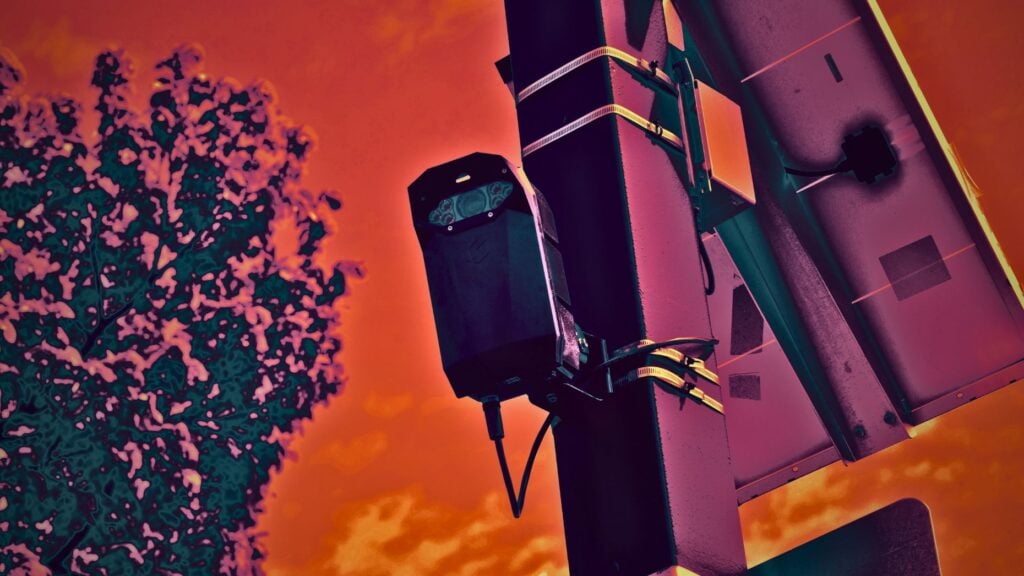
Each camera reads plates and logs vehicle details — make, model, color — as cars pass, then uploads that data into a searchable network. A local police department can search its own footage or, depending on the settings a customer chooses, access feeds from other agencies and private cameras across the country, according to the Electronic Frontier Foundation.
HOAs, property managers and businesses can run cameras that feed into that same national network or keep their data local. Whether an HOA’s cameras share into the network is a setting the board controls, Flock’s own marketing to HOAs states, and that choice isn’t visible to residents unless someone asks.
For a community, the setup is usually one or two cameras per entrance, billed as an annual subscription rather than a purchase. Supporters offer a simple pitch: A searchable record of every vehicle that comes and goes helps solve crimes after the fact and can substitute for staffed patrols.
What varies by contract and rarely gets disclosed to residents is how long that record is kept, who can search it and whether it’s connected to the wider law enforcement network at all.
How Flock cameras got into real estate
Flock’s earliest customers were homeowner’s associations, not police departments. A company marketing director told a Texas police sergeant that Flock typically starts with neighborhood HOAs, according to documents obtained by The Intercept. Research firm Contrary Research found HOAs made up more than 40 percent of Flock’s business as of 2021.
That relationship now runs through developers as well as existing associations. Flock’s marketing to builders promises the cameras will “boost long-term value” and states the system “transfers smoothly to HOAs” once installed. A developer signs the contract, sells the homes and hands new owners a surveillance system, its data-sharing settings and its liability along with the keys.
The economics can be significant. A Brentwood, California, HOA eliminated one of three security patrol shifts after installing four cameras, according to ABC7 San Francisco. The city has since said it approved the HOA’s camera permit by mistake and is ordering the system removed from the public right-of-way.
Other associations pay $2,000 to $3,000 per camera annually, according to reporting from the Fort Worth Report and the Raleigh News & Observer.
Why Flock cameras are controversial right now
Public support for the technology has fallen over the past year. This year, 46 percent of roughly 20,000 U.S. adults surveyed said they oppose license plate readers in their communities, compared with 38 percent who support them, according to YouGov data shared with The Washington Post. A year earlier, support outpaced opposition 45 percent to 33 percent — a reversal driven largely by rising opposition among Democrats and independents.
That shift has a face in Centerton, Arkansas, where city council member Justin Cowgur voted to approve a Flock contract two years ago and voted to cancel it this month after residents raised concerns at a meeting. He said he no longer trusts the company with the volume of data its cameras collect, telling The Washington Post: “Do you want somebody looking in your backyard 24 hours a day?”
The politics cross party lines and have now reached the White House. President Trump said this week he supports the cameras “because of law enforcement,” while acknowledging critics see the technology as “an infringement,” according to The Post. That puts him at odds with members of his own party.
Florida Gov. Ron DeSantis called the cameras “out of control” and said he doesn’t want Florida to “become a surveillance state,” per the same report. Rep. Keith Self posted that “Big Brother has NO place in the Lone Star State,” The Post noted, citing his Instagram post.
Rep. Andrew Clyde, whose home state of Georgia houses Flock’s headquarters, wrote that “Flock cameras belong in Communist China, not the United States of America,” according to an earlier Washington Post report. Sen. Josh Hawley has pushed for a federal investigation, and Rep. Chip Roy has warned that combining mass surveillance, government and artificial intelligence threatens personal freedom, per that same Aug. 28 report.
Opposition runs across the aisle, too. Democratic Michigan Senate candidate Abdul El-Sayed released a campaign video criticizing the spread of Flock cameras nationwide, The Post reported, linking to his video. Florida House member and Democratic Senate candidate Angie Nixon said she wants to “defund Flock cameras,” citing officers who have misused the network to track former partners, according to the Aug. 28 Washington Post report.
In Florida’s governor’s race, Republicans James Fishback and Byron Donalds have both opposed the cameras, while Democrat David Jolly has called for warrant requirements rather than an outright ban, according to ClickOrlando.
Flock has defended its record. A company spokesman told The Washington Post that internal data shows “there is wide support for ALPR technology.” Chief executive Garrett Langley told Fox News that balancing privacy and safety isn’t a binary choice, saying, “What we have to prioritize as a country is compromise.”
What agents are already seeing
Buyer reactions to license plate readers are often split along generational and lifestyle lines, according to agents who spoke with the National Association of Realtors. In gated and golf communities, the systems are often marketed and received as a standard security amenity, and buyers there frequently expect some form of electronic monitoring, according to Matt Brown, a broker associate with William Raveis Real Estate in Naples, Florida.
Seasonal residents tend to view the cameras favorably, according to Greg Field of HomeSmart in Phoenix, who said the appeal is strongest among buyers who leave their homes empty for months at a time. Field said privacy-conscious and younger buyers react differently once they notice a camera mounted near a community entrance, asking who owns the footage and how long it’s retained. He said he has seen buyers remove specific subdivisions from consideration over the issue.
Mike Schwab, CEO of Association Online and a member of NAR’s 2026 REACH accelerator cohort, said HOA governing documents frequently don’t address surveillance technology at all, leaving no clear rule on whether a board has to disclose it to a prospective buyer. In many cases, he said, the only way to find out is to ask the association directly.
The disclosure question nobody has settled
Colorado’s Division of Real Estate offers the only state-level guidance found addressing camera surveillance in real estate transactions. It instructs listing agents to find out whether video surveillance devices are present in a home and share that with buyer’s agents, and recommends disclosing cameras in the MLS comment field.
That guidance covers in-home devices during showings. It doesn’t address perimeter systems an HOA operates at a neighborhood entrance.
Schwab’s point stands as the sharpest fact in this story: No precedent currently requires an HOA to disclose its surveillance contract to a prospective buyer, one way or the other. That gap sits underneath a technology now contested at the level of a presidential aside and a governor’s press conference, with no agreed rule for whether it belongs in a listing disclosure at all.
The legal exposure is real and largely unreported
A February California appellate ruling, Bartholomew v. Parking Concepts, found that failing to post a required privacy policy for license plate reader systems is itself actionable, with no need to prove misuse. Minimum damages are calculated at $2,500 per unique vehicle scanned during a noncompliant period, according to a client alert from law firm Brownstein Hyatt Farber Schreck.
The decision covers parking operators, shopping centers and office parks broadly, not Flock specifically, though Flock is the dominant vendor in the space.
In California, individual HOA board members can also face personal liability for misusing camera data under state civil code, separate from the association itself, according to a fact sheet published by law firm MBK Chapman.
What agents and boards should be watching
The legal and political ground under this technology isn’t settled yet. A company that started by selling to HOA boards now sits at the center of a national argument it didn’t have five years ago. None of the conversation has produced an answer to the one question real estate touches directly: Whether a buyer is owed an HOA’s surveillance contract before closing.
Until a state commission or an MLS says otherwise, agents are applying guidance built for a doorbell camera to a network that logs everyone who drives in.
Agents can still answer the questions buyers are asking, even without a disclosure rule to point to. The split NAR describes falls along fairly predictable lines.
Buyers in gated and golf communities tend to expect some form of monitoring and may treat a camera at the entrance as a selling point. Younger and privacy-conscious buyers are more likely to ask who owns the footage, how long it’s kept and whether the HOA shares it with police.
Neither reaction is wrong, and an agent doesn’t need to guess which one a given client will have before a showing.
What an agent can do, regardless of how a buyer reacts, is ask the HOA for the information directly, since nothing currently requires the association to volunteer that information. The questions worth asking mirror what an attorney would ask: Whether the system feeds a national law enforcement network, how long footage is retained, who can access it and whether residents can register for an opt-out, such as Flock’s “Safe List,” per NAR’s reporting.
Getting those answers in writing before a buyer commits is the closest substitute available to a disclosure rule that doesn’t yet exist.