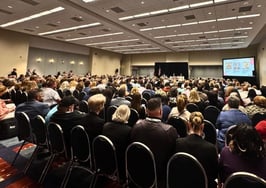

A growing share of baby boomer homesellers have never sold a property before — and most agents aren’t treating them any differently than experienced sellers, National Association of Realtors Deputy Chief Economist Jessica Lautz told attendees Tuesday at NAR’s 2026 Legislative Meetings in Washington.

Jessica Lautz
The session, held at the Walter E. Washington Convention Center, drew a large crowd of conference attendees for what became one of the conference’s most data-dense presentations on residential market trends. Lautz and NAR Chief Economist Lawrence Yun each presented, then fielded questions together in a joint Q&A led by Mark Donnelly, vice chair, Residential Economic Issues and Trends Forum, NAR, and Chris Duf, COO and co-owner of Beach Real Estate Group.
The 1st-time seller opportunity
Lautz opened her remarks by reframing how agents should think about their potential client pool. The median homeowner has now been in their home 11 years, she said — a figure that has climbed steadily since the Great Recession as owners shifted away from treating their homes as short-term equity trades.
“We talk incessantly about first-time homebuyers,” Lautz said. “What about first-time sellers?”
The question wasn’t rhetorical. Lautz said 17 percent of younger baby boomers who sold a home this year had never sold a property before. That cohort, she said, is entering the market with substantial equity and genuine motivation but almost no understanding of the process — and agents who recognize that gap have a client acquisition opportunity most are missing.
To illustrate, Lautz described a relative who had owned a condo for 20 years and called her with basic questions about how a sale works and where her equity was held.
“She literally asked me, ‘Do I need to be painting?'” Lautz said.
The knowledge gap extends beyond logistics. Lautz said many in this cohort are receiving advice from peers who purchased their homes in the 1970s and never moved, compounding misinformation about down payments, process and timing that agents are well-positioned to correct.
Why boomers are moving — and where
Contrary to conventional assumptions, younger baby boomers are not primarily moving to downsize, Lautz said. The median change in square footage for that group is zero. The more common driver, she said, is proximity to family, particularly grandchildren, regardless of whether the millennial children want them nearby.
“They’re coming,” she said, while the audience replied with laughter.
For older baby boomers, Lautz said the median decrease in square footage is around 200 square feet, modest enough to suggest the motivation is less about space reduction and more about floor plan, maintenance load and aging-in-place considerations.
9 more client profiles agents are missing
Lautz also identified nine other buyer and seller profiles she said agents are underserving, including single men, child-free households, Gen Z buyers using government loan programs at higher rates than expected and “HENRYs” — high earners, not rich yet — who she described as motivated by aspiration and likely to trade up within a decade.
On single men specifically, Lautz said their homeownership rate has been flat since the 1980s despite earnings roughly on par with single women, who have outpaced them as first-time buyers. She said the data offers no clear explanation but frames the gap as an opportunity.
“We need to bring them in,” she said.
The charts from Lautz’s presentation can be viewed here.
Sentiment vs. reality
Yun, who presented before Lautz, said current consumer sentiment is lower than it was during the 2008-2009 foreclosure crisis — a period marked by 8 million job losses, unemployment near 10 percent and a wave of distressed sales that reshaped the market for years.
Today, by contrast, the stock market is at record highs, foreclosures represent roughly 1 percent of transactions and total employment has reached a record high.
“I sometimes wonder if this economic sentiment index is capturing some of the political sentiment,” Yun said, suggesting that respondents’ views of whoever occupies the White House may be skewing the data.
Rates, inventory and the $1M median
Yun said home sales have remained sluggish through the first half of 2026, with year-to-date volume up less than 1 percent nationally. He attributed part of the stall to mortgage rates that have not moved despite conditions that would historically push them lower — including progress toward a peace agreement he referenced the prior day. The 10-year Treasury, which mortgage rates track, has not responded as expected, he said, and he is monitoring that gap closely.
Prices, however, are not slumping. Yun said home price growth remains on a trajectory that, under most scenarios he modeled, puts the national median at $1 million within roughly 25 years. The current national median is approximately $430,000. In 1990, it was $90,000.
“Anyone who is saying there can be a 30 percent price decline — show this chart,” he said, referencing the long-term appreciation curve.
A tale of 2 job markets
Yun also addressed the geographic split in job growth, noting that roughly half of states have fewer people receiving paychecks today than a year ago, with the Washington area among the hardest hit due to federal workforce reductions. States in the Southeast and Rocky Mountain region continue to lead on job creation, he said.
On inventory, Yun said lifting the capital gains tax exemption on home sales would be among the most direct policy levers available to bring more supply to market, particularly for older homeowners who are effectively locked in by the tax exposure a sale would trigger.
The charts from Yun’s presentation can be viewed here.
Pushing back on social media noise
During the Q&A, both economists pushed back on social media narratives they said are distorting buyer behavior. Lautz cited claims circulating online that transaction cancellation rates are running at 20 to 30 percent, a figure she called disconnected from NAR data showing cancellations at around 5 percent of ratified contracts.
Yun flagged persistent social media content predicting a 30 percent home price crash, which he said runs counter to every supply and distressed-sale indicator NAR tracks.
“People’s decisions are driven not necessarily by data, but they’re determined by perception,” Yun said.
Reasons for cautious optimism
Both closed on a note of cautious optimism. Lautz said first-time buyer share in the most recent existing home sales report reached its highest point since June 2020. Yun said the recent uptick in sales activity, occurring even without meaningful mortgage rate movement, may signal that buyers are growing accustomed to the current rate environment after three years of suppressed demand.
“You can only suppress certain market demand for so long,” Yun said. “After three years of suppression, that is just bound to burst out.”