
Buyers and sellers can smell a memorized script from across the kitchen table, and the moment they do, your credibility drops. The fix is not a better script. It is learning to explain your value and handle objections with stories and analogies built for the specific person in front of you.
TAKE THE INMAN INTEL INDEX SURVEY
Here is the simple system I have taught real estate professionals for years to do exactly that, on the spot.
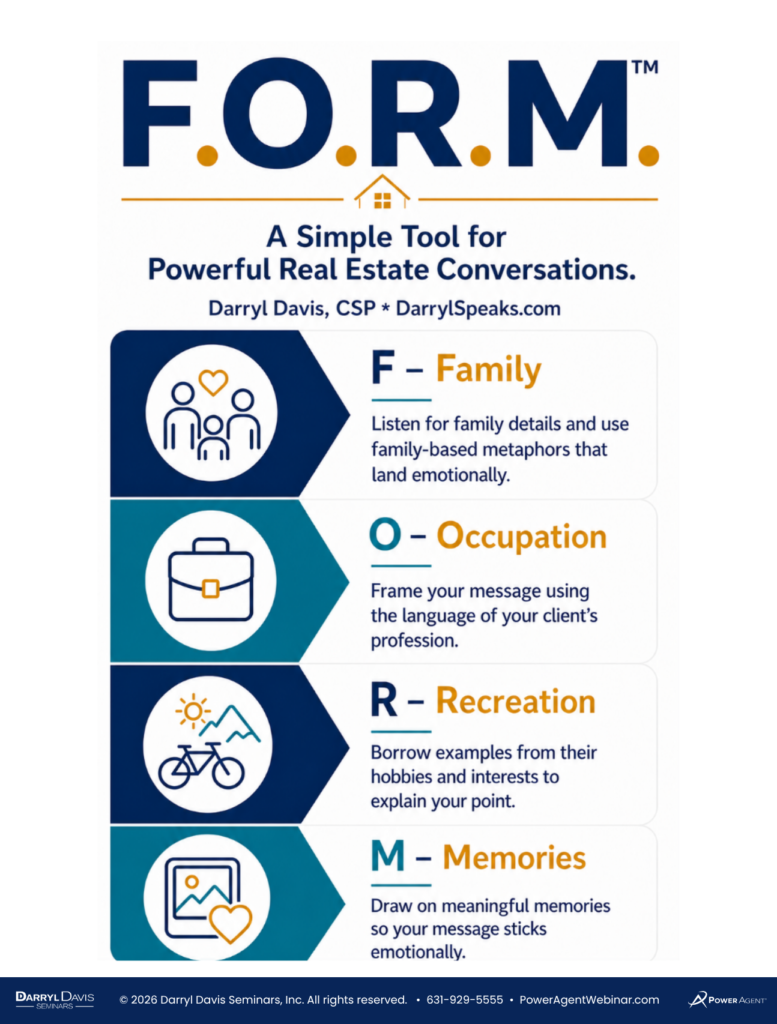
A script is off-the-rack. It fits no one perfectly. A custom metaphor is tailored, cut to the person sitting with you. The acronym that lets you tailor on the fly is FORM: Family, Occupation, Recreation, Memories.
Gather the raw material during rapport
FORM is not something you spring at the closing table. It is intelligence you collect during the interview, while you are building rapport and asking about where they want to go next. As they talk, you are quietly filing away four things.
- Family gives you the most emotion: Young kids? Compare your marketing to raising a child or a kid learning an instrument. Parents feel that instantly, because they live it daily.
- Occupation lets you speak their language: This is my favorite. A contractor gets why you do not skip steps. A nurse gets triage and timing. Frame your process in the terms of their trade, and you sound like one of them.
- Recreation opens a friendly side door: Golfers, travelers, fishermen, movie buffs. Explain pricing to a golfer through club selection. Explain exposure to a traveler through booking the right flights.
- Memories carry weight: A trip they loved, a wedding, the day they bought this home. Big memories hold big emotion, and emotion is what makes an analogy stick.
Put it to work on an objection
Say a seller who teaches third grade tells you, “I think I can just sell it myself.” Reach for her world.
“You know how a motivated parent can teach a child to read at home, and some really do a wonderful job? Yet schools still exist, because there is a whole system behind getting consistent results for every child. Selling a home is similar. You absolutely could do parts of it. My job is the system around it, the exposure, the negotiation, the dozen things that go sideways if no one is managing them.”
That lands far softer than “How many homes have you sold?”
2 more objections, handled with their world
Say a homeowner who runs a small construction business tells you, “I think my buddy in the business will just handle it.” Reach for the trade.
“You know how someone can hire a guy who frames on the weekends, and sometimes it works out fine? But when it is their own house, most people want the licensed pro who does it every day and stands behind the work. I am the full-time professional for the biggest sale of your life. Your friend may be terrific. The real question is whether this is the deal you want to learn on.”
Or the discount objection from a frequent traveler: “Another company will do it for less.” Use the road.
“When you book a trip, the cheapest flight is not always the one you take, right? Sometimes the bargain has three connections and lands at midnight. Price is one number on the page. What you are really buying is whether you arrive smoothly. My job is to get you to the closing table smoothly, and that is where the real money is made or lost.”
The questions that fill your toolbox
None of this works if you walk in cold, so collect FORM intelligence with simple, genuine questions while you build rapport. Map them to the acronym so nothing slips by.
- Family: Who lives here with you? How long have the kids been in the local schools?
- Occupation: What do you do for work? Has it been busy lately?
- Recreation: What do you love to do when you are not working?
- Memories: What will you miss most about this home? What is your favorite memory here?
By the time an objection surfaces, you already have the perfect frame waiting, drawn from their own life rather than a script.
Let it be imperfect
Watch your timing, too. The goal is not to ambush a homeowner with an analogy the second they raise a concern. Listen fully first, let them feel heard, and then offer the picture. A metaphor delivered too quickly feels like a tactic. The same metaphor delivered after genuine listening feels like understanding, and understanding is what earns the listing.
Your first homemade metaphors will be a little clumsy, and that is fine. Repetition smooths them out. The clumsiest custom analogy still beats the slickest canned line, because it was built for that person.
So, at your next appointment, stop rehearsing lines and start listening for Family, Occupation, Recreation and Memories. Find those, and the perfect metaphor practically builds itself.
Darryl Davis, CSP, is a nationally recognized real estate speaker, bestselling author and coach with more than 40 years in the industry. Learn more at darrylspeaks.com.