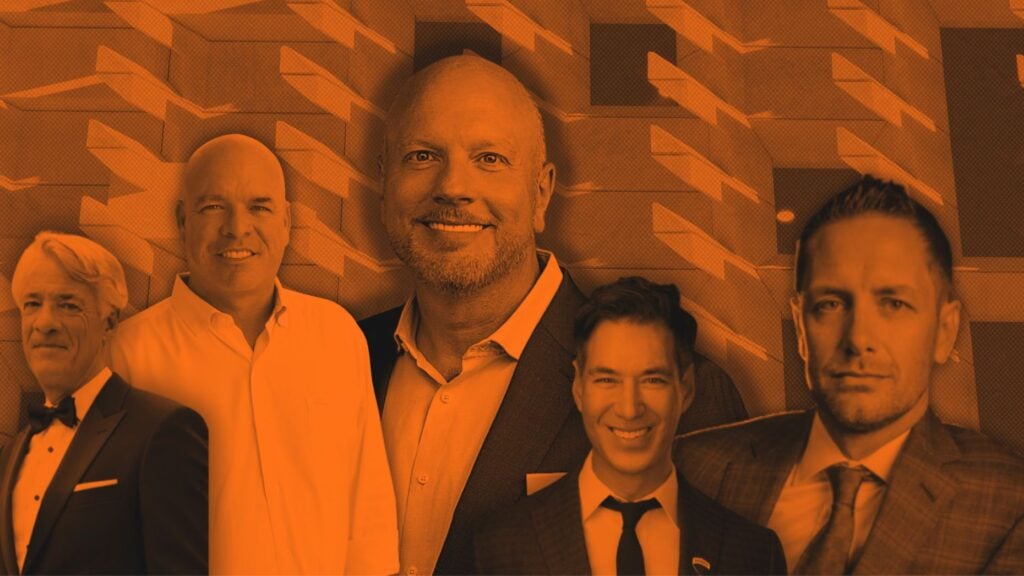
Rechat CEO Shayan Hamidi recently joined the new Inman Advisory Council, and ahead of his multiple speaking slots at Inman Connect San Diego, he sat down to talk with us about where he thinks real estate is headed.
His main point: The industry doesn’t have a software problem; it has an artificial-intelligence workforce problem. Real estate agents, he says, already have too many disconnected tools doing too little — what he calls “a genius with amnesia.”
The winners over the next few years, he argues, will be the ones who stop buying more software and start building a connected AI workforce instead.
Below, Hamidi chats with Inman about agentic AI, the death of the “co-pilot” model, the best advice he ever got about building a company and what he thinks the industry actually needs from trade media right now.
The following conversation has been edited for length and clarity.
Inman: A couple of years from now, what do you think the typical real estate agent’s day-to-day is going to look like with all these technology changes, with AI and some of the platforms they’re using?
Shayan Hamidi: The first thing to address is that I do think there will absolutely be a role for agents in that four- or five-year timeline. A lot of folks think AI will replace agents entirely. I don’t think that’s the case.
What you’re going to see first is that agents will be able to scale the number of relationships they cater to because a lot of the busy work, the grunt work, will be handled by AI. So now they can manage more.
I think the big vision for agents and brokers has always been similar to a stockbroker. That industry transitioned from just selling you stocks to becoming wealth advisors, staying with you long-term and helping manage your wealth against your goals. We’ve always wanted that in real estate, but it’s always been transactional — you do the deal, and the agent moves on.
You hear it from every sales trainer: Stay in touch, remember the anniversaries and birthdays, send relevant data. But the math doesn’t work. If you’re trying to do that for 500 relationships, you’re never sleeping, and you probably need three other people helping you. So people didn’t do it as much as they wanted to.
Now, with AI, all of that gets taken care of. Agents get elevated. They’re more on the relationship side and can serve a much larger group. That’s one transition.
The other thing I foresee is that agents will manage a lot more than just the transaction. They’ll become a kind of homeownership advisor or lifestyle advisor. Not just selling the house, but helping clients transition into the neighborhood and beyond.
So what will the day-to-day look like? It’ll look like what a solid agent’s day-to-day looks like today on a team with a lot of dedicated support staff. That team model has been proven in the industry. If someone can focus purely on the relationship side while others handle marketing and operations, they can manage much higher volume. AI essentially makes that free.
Not every agent can afford a team, but now you’ll have an AI that does your marketing, an AI that lists for you — specific AI agents doing the work. We’re moving away from the “co-pilot” notion of a single assistant helping you do your job better.
Instead, you’ll have a marketer, a lister, all these functions handled by AI, freeing agents up to go back to basics: meeting people, having coffee — the one-on-one relationship work AI will never replace. But now, with much more support and on a different scale.
I imagine you’re paying close attention not just to proptech, but to AI and tech more broadly. What’s something you’re really interested in right now in the AI or tech world outside of real estate?
I think there’s a general theme of what’s possible today. We’ve seen the rise of agentic AI — AI that can execute a bunch of tasks, make decisions and carry out sophisticated workflows — impacting all kinds of industries.
One of the major things we’re seeing is that with agentic AI and connected data layers, we’re actually seeing AI get the work done. This is true for real estate but also for other industries: There’s an endless amount of software out there. Almost no industry needs more software.
What we need is AI to get the work done. We’re seeing this “AI as workforce” shift everywhere. On the sales side, you have AI business development representatives. In health sciences and other fields, you’re seeing the rise of a workforce that’s no longer human, but AI actually getting the work done.
What’s fascinating is that our industry has been through some tough times the past couple of years, which has made operators sharper. They’ve been asking, “Why would I pay for this just because it looks cool?” They’ve gotten conscious about margins and shifted toward an outcomes-based mindset, which aligns really well with this idea of an AI workforce actually delivering results.
We’re seeing this in every part of our own company, too. We’re aggressively hiring more AI workforce across every department, from HR to sales to customer support to product development, design and marketing. Every department has an AI plan, hiring AI to do more of the work, and the human team is elevating as a result.
I think earlier this year, companies were talking about using AI to cut costs. Does the AI capacity roughly even out with what a human workforce would cost, or is it about the same?
Cutting costs through AI is very real. For most things today, AI is just cheaper to get the work done. But what’s fascinating is that it started as a cost-cutting conversation and is now shifting to look at all the work we can get done that we never could before, capabilities we never had. That opportunity is much bigger than the cost-cutting angle.
Companies and contractors can think bigger now. They can offer more services, do things they never could before. That’s proving to be a much bigger story than efficiency alone.
For example, if you want every contract that comes through your company reviewed by legal counsel, that’s incredibly expensive, so companies usually send only the important ones and just sign the rest. Now AI can review every single one and give you feedback. There’s so much that just wasn’t affordable or feasible with the resources companies had before.
What’s a piece of advice you got early in your career about building a company that you’ve found most valuable?
One important notion is that building a real company and a real product takes time. There are no overnight successes. You need to think long term, which means going back to the core, first-principles basics of what matters to people.
There’s a great story about Jeff Bezos. Someone once asked him what Amazon would be building 10 or 15 years from now, and he said he didn’t know the answer to that, but he did know one thing: No customer is ever going to tell you to make shipping slower, make products more expensive or say, “You’re a little too cheap.”
Customers always want faster, better and cheaper. So thinking about the first principles of what you’re building, paired with a long-term vision, is extremely important once you actually get into it.
That’s something that’s stuck with me, especially because there are a lot of good ideas — and a lot of trends — that pop up every day. Right now, everything is “AI this, AI that,” and it’s easy to get pulled into chasing anything AI-related, just as it was when the internet first came out. But it’s important to go back to first principles and assess from there.
So it sounds like not chasing every trend that comes along.
Exactly, and it’s extremely tough. Being able to tell what’s a trend versus what’s actually real, what’s going to have a fundamental impact and transform things.
Even within AI, there’s a lot that’s just trendy. Look at the biggest AI companies. Most chased after flashy things you can do with AI: generating images, emojis, videos. Anthropic (Claude) obsessed over one thing — using AI to write code — and that turned out to be a trillion-dollar idea, much bigger than anything else.
Being able to detect what’s a real, fundamental shift versus what just sounds exciting today and will fade, that’s the real skill. If you can bring the cost of building software down to zero, the world transforms. We’re seeing that happen in real time.
I also wanted to ask about the upcoming Inman Connect San Diego conference. I know you’ll be busy, speaking a few times. What are you most looking forward to, and what will you be speaking about?
I’ll be speaking about a few different AI-related topics — the AI workforce and the theme that the industry has enough software; what it needs is more of an AI workforce.
One key thing: If you have 15 or 18 different products to get your work done — which is common in real estate — you end up with a bunch of segregated AI assistants across different silos. Essentially, you have “a genius with amnesia,” because none of them have access to anything else. That’s why having a connected layer of data is so important. If the industry doesn’t invest in that now, it won’t be able to take advantage of what comes next in AI.
More broadly, I think the industry is going through its biggest transition ever — probably bigger than the internet — including in how people get their information. There’s no shortage of headlines in this industry; what we really need is a map.
I hope Inman can play that role for the industry as agents and brokers navigate this shift. Being part of that conversation, not just commenting from the sidelines, is exciting to me, and this is the best time to do it.
What advice would you give to someone attending Inman Connect for the first time who wants to get the most out of it?
Do your homework beforehand. There are two things you get out of these events: networking and content. You can get content from the comfort of your sofa with an Inman subscription. But showing up in person means recognizing that everyone else has made the same investment and that this is a people-person industry.
I highly recommend doing homework on who’s going to be there and who you should talk to, so you can actually network once you’re there. There are usually events after the main conference, too — receptions and the like — and I recommend participating in those. The conversations that happen in those rooms are invaluable; you don’t find them online.
Content matters too. Inman is strong on that front, and this is a special time in the industry, so it’s worth staying tuned in. Get the agenda ahead of time, find out who’s speaking and on which topics, and bookmark sessions in the app, or add them to your calendar so you don’t miss anything.
Pre-booking meetings is also a great idea, since people get so busy. If you’ve pre-booked and put it on your calendar, that’s a win.
You recently joined the Inman Advisory Council, whose goal is to get expert opinions like yours on how to remake Inman into a dynamic media, membership and community platform. What do you think the real estate industry needs most from trade media sources right now?
I touched on it a bit earlier. I think the industry doesn’t need more headlines; it needs a map. My hope is that Inman becomes the place that helps agents and brokers navigate the shift underway, whether it’s AI or industry consolidation. Not just reporting on it and adding to the noise, but providing clarity on what to actually do about it.
I think in a moment of this much change, the storyteller matters as much as the story. That’s why I joined this advisory group, and that’s what I’m hoping to contribute.
The timing wasn’t an accident. The next three years will decide who thrives in this industry for the next 30. And the conversation needs voices from people actually building the technology, not just commenting on it.
I think it’s great that [Inman CEO] Tom [Bohn] is coming into his new role with a fresh perspective on how media can serve our industry. The timing couldn’t be better. This is the biggest transition since the internet. Maybe bigger.