
A small-town North Carolina church just secured a conditional rezoning for a 30-acre campus expansion that includes transitional housing, vocational classrooms and 12 single-family residential lots — without a state law requiring it.
Across the country, legislatures are moving to make deals like that easier, faster and more common, and at least one city is already showing what implementation looks like on the ground.
The “Yes in God’s Backyard” movement — known as YIGBY — is expanding rapidly across the U.S., with California, Florida and Virginia among the states that have enacted laws allowing faith-based organizations to build housing on land they own, and more than a dozen additional states considering similar legislation.
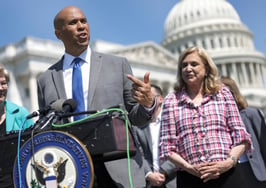
A federal bill introduced in January by Reps. Nanette Barragán, D-Calif., and Shontel Brown, D-Ohio, would layer grant funding and technical assistance on top of state-level progress. The question for real estate professionals is no longer whether faith-based land enters the housing pipeline. It is how to work with it when it does.
The land is there
Faith-based organizations own more than 84 million square feet of land in New York City alone, according to a 2025 policy brief by the NYU Furman Center. Of that, approximately 5.5 million square feet consists of vacant lots and surface parking — enough to support roughly 22,000 units of housing, the brief found.
Nationally, faith communities collectively hold more than 2.6 million acres, much of it underused, with the potential to support as many as 800,000 new homes, according to Realtor.com.
California enacted what is considered the first statewide YIGBY law in 2023, allowing faith-based institutions and nonprofit colleges to build affordable, multifamily housing on land they own by streamlining permitting and overriding local zoning restrictions. The law requires 100 percent of units to be affordable to lower-income households, with up to 20 percent allowed for moderate-income households, according to the Furman Center.
Florida followed in 2025, passing Senate Bill 1730, which gives local governments the ability to approve affordable housing on eligible land owned by religious institutions, even if that land is not currently zoned for residential use, according to Stateline. Now one Florida city is turning that law into action.
St. Petersburg on Tuesday formally launched a YIGBY program — the first local government in Florida to adopt the provision into city code after councilors unanimously approved it in December, according to Patch. The city’s Office of Community Impact will lead the effort, with the Florida Housing Coalition serving as technical assistance consultant.
The program will offer education and one-on-one support to congregations, including help evaluating site feasibility, navigating the city’s review process and accessing funding resources such as the state’s Predevelopment Loan Program.
Virginia’s Faith in Housing Act passed both chambers of the General Assembly earlier this year and was signed by Gov. Abigail Spanberger in April. The law eliminates the rezoning step for faith-based organizations and tax-exempt nonprofits building affordable housing on their properties, with an effective date of Jan. 1, 2027.
The St. Pete launch in particular comes as advocates watch closely whether YIGBY laws produce actual housing at scale. A February 2025 report by YIMBY Law, a pro-development nonprofit, assessed five California housing streamlining laws passed since 2021 — including SB 4, the state’s YIGBY law — and found that as of the report’s release, no projects had made use of the new option, according to CalMatters.
The report attributed early ineffectiveness to affordability mandates, labor requirements and local government resistance. Zoning reform clears the path, but financing, technical capacity and political will determine whether anything gets built.
What it looks like on the ground
In Mint Hill, North Carolina, a small town southeast of Charlotte, the Shiloh Truelight Church did not wait for state legislation. The congregation’s longtime minister, Mike McGee, filed petition ZC25-5 last year, seeking conditional zoning to expand the church’s 150-acre campus.
The expansion includes dormitories, classrooms, a family life center and 12 single-family residential lots — the last of which, McGee noted at the public hearing, could eventually be developed as cottages similar to church-owned homes nearby that currently house Ukrainian refugees.
The project is intended as a transitional housing program for homeless individuals and families, structured around vocational training and a substance-free environment. McGee cited a partner program at Greenville Tabernacle Church in South Carolina and local ministry One7 as models the church had studied.
The approval drew support and pushback. Sydney Newell, executive director of One7 Ministries, told the board the need for transitional housing was greater than any single facility could meet, and she fully supported the project. Jim Ford, vice president of a nearby neighborhood association, argued the density and use type were inconsistent with the town’s half-acre lot standard and asked whether the board wanted a large residential program in a rural area.
The board approved the petition.
What agents need to know
Anna Granger, broker-in-charge at 1st Choice Properties in Mint Hill, said faith-based developments can affect surrounding comparables and inventory in localized ways.
“A project like this can change the highest-and-best-use signal for nearby land, add a new supply type to the immediate area, and influence buyer perceptions around traffic, use intensity and neighborhood character,” Granger said.
She said title and transaction complications arise more frequently than in standard residential deals when a religious organization is the landowner or developer. Agents should watch for authority-to-convey questions, deed restrictions, easement and access rights, and survey or boundary issues, she said.
“If church-campus and faith-based mixed-use developments become more common, agents should treat these deals more like small-scale institutional-developer partnerships than standard residential listings,” Granger said.
On the question of whether units in projects like this should be open to the general public rather than reserved for congregation members, Granger said the distinction matters both practically and politically.
“Ideally, those units should be open to the general public to provide affordable housing opportunities for everyone,” she said. “Neighbors may worry the project is more about internal church use than community benefit, which can increase opposition or scrutiny at rezoning hearings.”
From a market perspective, Granger said faith-based housing is unlikely to move the needle broadly in a market like Mint Hill on its own. “I don’t see that being a major factor for Mint Hill,” she said. But she added that multiple projects pursued by various congregations could change the character of an area over time.
For buyer clients in neighborhoods where projects are proposed or approved, Granger said the priority is framing the development as a known, quantifiable factor rather than an undefined threat — and helping clients determine whether it is a pro or a con for their specific situation.
The Mint Hill approval illustrates a pathway that does not depend on state legislation: A faith-based land use win secured through a local conditional rezoning process that opens a path to residential lots. Whether it produces sellable inventory in five years or 10 depends on the timeline. But the zoning is already done.