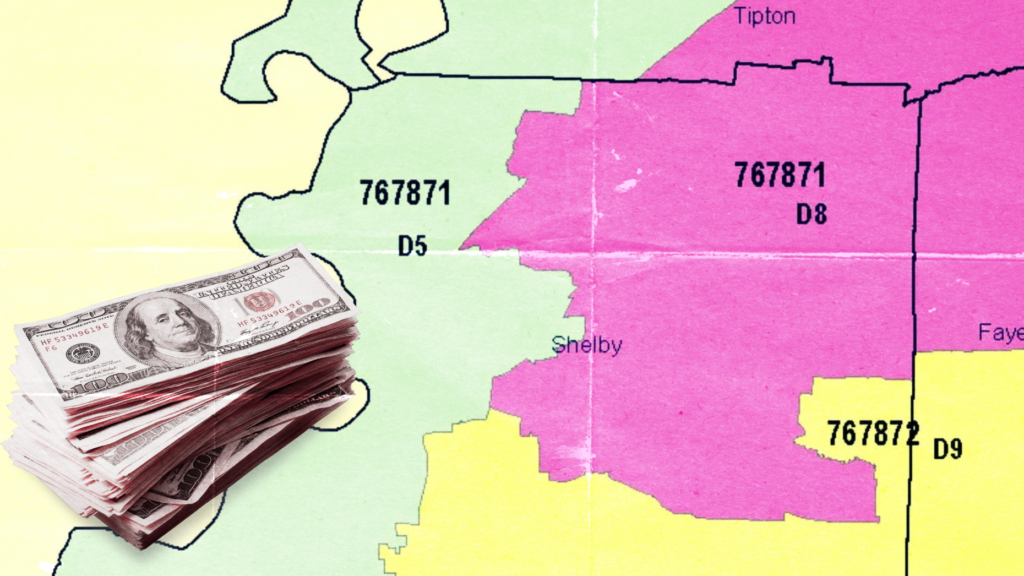

Tennessee’s congressional map was recently redrawn after a chaotic and highly charged special legislative session. And according to campaign finance records, the real estate industry has donated a significant chunk of cash to the politicians who drew it.
In the past five years, three top Republican officials who led the charge to redraw the state’s congressional map collectively received $407,000 in campaign contributions from the Tennessee Association of Realtors, according to a campaign finance records database compiled by Tennessee Lookout.
Following the heated protests of the redistricting process, some Tennessee real estate agents are demanding answers and asking why their contributions to the Tennessee Association of Realtors Political Action Committee (RPAC) go to politicians they say violate the association’s Ethics Code.
The money trail
In the past five years, the Tennessee Association of Realtors distributed roughly $1.9 million in campaign contributions to state politicians. The Tennessee Republican Caucus received $272,000 during that period, while the Tennessee Democratic Caucus received $94,000.
The Tennessee Association of Realtors’ $1.9 million in campaign contributions in the past five years was the most in the state, slightly ahead of HCA Healthcare and Wine and Spirit Wholesalers of Tennessee, according to the database.
Over the past five years, House Speaker Cameron Sexton, who eventually led the House redistricting effort, received $190,000 from the Tennessee Association of Realtors, tying it as his largest donor.
During that same period, Gov. Bill Lee received $17,000. And Lt. Gov. Randy McNally received $200,000, making the Tennessee Association of Realtors his single largest donor. Combined, the three architects of the congressional redistricting collected $407,000 from the Tennessee Association of Realtors’ political arm in the past five years.
McNally presided over the special redistricting session, publicly championed the new maps on social media and blocked state Sen. Charlane Oliver from voting after she protested on the floor. He later punished Democratic senators by reassigning committee slots and limiting per diem reimbursement.
Lee called the special session after a conversation with President Trump, following the U.S. Supreme Court’s Louisiana v. Callais ruling, and signed the new map into law after it cleared both chambers.
The Tennessee Association of Realtors’ contributions to top Republicans are not necessarily unusual, given that the GOP has dominated state politics for more than a decade.
The GOP controls the governor’s office and a supermajority in the Senate and House of Representatives. Republicans also hold both of the state’s U.S. Senate seats and eight of the state’s nine U.S. House seats.
But the concentration of contributions to the architects of one of the state’s most consequential political restructurings in more than half a century is drawing scrutiny from some Realtors in Tennessee.
‘Those principles should not disappear’
Rodney Tate Jr., a Memphis-based Realtor, and Nathan Weinberg, co-founder and principal broker at MW Real Estate in Nashville, published an op-ed in the Tennessee Lookout on June 2 that directly called out the Tennessee Association of Realtors.
“As licensed professionals, Realtors are held to high ethical standards,” they wrote. “Those principles should not disappear when political contributions are involved.”
The op-ed cited Article 10 of the Realtor Code of Ethics, which prohibits discrimination based on race, religion, sex, disability, familial status, national origin, sexual orientation or gender identity. They noted that Tennessee Realtors’ own website states candidates may lose funding if they violate those standards. Tate and Weinberg argued that the standard hasn’t been enforced in this case.
“Millions of RPAC (Realtors Political Action Committee) dollars have continued flowing to lawmakers advancing legislation that attacks LGBTQ+ Tennesseans, disenfranchises Black voters, targets immigrants, weakens public education and promotes policies many Realtors believe directly contradict our profession’s stated values,” Tate and Weinberg wrote.
They called for RPAC to stop contributing to lawmakers who promote discriminatory legislation and ensure contributions align with fair housing and equal representation.
‘It’s dangerous to be here’
Some Tennessee-based real estate agents said the redistricting isn’t just a political story but a housing story.
Colleen Weiss, a Nashville-based Realtor at MW Real Estate, is leaving the state. Originally from St. Paul, Minnesota, she moved to Nashville in 2009 and received her real estate license in 2022. She and her husband plan to return to Minnesota soon.
“I show up at the State Capitol regularly during session. I fight for Tennesseans, but I’ve reached a point where I can’t keep doing it,” she said. “I’m raising girls here, and the life I want for them feels less and less accessible in this state.”
Weiss said she recognizes that leaving is a major privilege. “It’s genuinely sad. But yeah — I’m taking the bait, and I’m going,” she said.
Sara Lederach, a Nashville-based Realtor, also connected the political climate directly to population movement.
“I think we’re already seeing people choose to leave the state because of regressive Republican policies,” Lederach told Inman. “I’ve personally seen families move because they have trans kids who need access to healthcare. If the redistricting succeeds in eliminating meaningful representation for people like me, I think we’re going to see more of that. It’s dangerous to be here.”
Tennessee’s population rose 5.8 percent between April 2020 and July 2025, according to U.S. Census Bureau data, and Nashville’s rose 4.6 percent over the same period.
The state is still growing. But for Realtors like Weiss and Lederach, the question is who’s arriving and who’s being pushed out, and whether those decisions are being made, in part, with their own money.
‘This map diminishes Memphis’
The redistricting — called through a May 2026 special session convened by Lee at the urging of President Trump — carved up Memphis’s 9th Congressional District, the state’s only majority-Black district and its last Democratic-held congressional seat, into three pieces spread across heavily Republican rural districts.
Tennessee became the first state to redraw its congressional maps after the Supreme Court’s April 29 ruling gutted a Voting Rights Act provision that had required states with a history of racial discrimination to create majority-minority districts.
State Sen. John Stevens, a Republican who introduced the map for its final Senate vote, was candid about the intent.
“Tennessee is a conservative state, and this map ensures that our congressional delegation reflects that,” Stevens said. “This is about allowing Tennessee to maximize its partisan advantage.”
The bill passed the Senate 25–5. State Sen. London Lamar, a Memphis Democrat, delivered one of the sharpest rebukes from the opposition.
“This map diminishes Memphis,” Lamar said. “Racism doesn’t become less racist just because it’s called partisan.”
‘We don’t know how much, how often or why’
Inside the industry, the backlash against Tennessee RPAC had already been building, and now it’s going public.
Weiss told Inman that she hadn’t opted out of RPAC contributions before because she didn’t realize she could. That’s changed.
“There was probably a part of me that wanted to believe I was supporting lobbyists fighting for property rights and homeownership,” Weiss said. “That’s still the only reliable way for people to build generational wealth in this country. But what we’ve been accepting without acknowledging is that supporting RPAC means supporting specific candidates, and we don’t really know how much, how often or why.”
Weiss said her political engagement sharpened after the 2023 Covenant School shooting in Nashville, when she began showing up at the State Capitol during session and pressing real estate leaders on RPAC’s political direction. She said the response was a familiar line: RPAC doesn’t support individual candidates.
“Meanwhile, they absolutely are supporting major Republican leadership here in Tennessee,” she said.
The transparency problem, Weiss said, runs in only one direction. Members have no way to see in real time which candidates their donations are backing. The information only becomes visible after the fact, through candidates’ own disclosure filings.
“From what I can tell, RPAC and the state and national associations aren’t forthcoming about where the money goes,” she said. “We only know which candidates received it because the candidates themselves have to disclose.”
Lederach, who has also opted out of RPAC contributions, described the contribution structure as one designed to be easily missed.
“Every year when we renew our dues, there’s a long form — you’re paying the Tennessee Association of Realtors, you’re paying the national association — and the RPAC contribution is just sort of buried in there,” Lederach told Inman. “It’s a box you have to uncheck, but you’d also have to notice it.”
Lederach, who has lived in Tennessee for 21 years and received her real estate license five and a half years ago, said the Tennessee Realtors’ Association incentivizes donating.
“I was on the Public Education Committee, and they wanted the committee to raise a certain amount for RPAC that year,” she said. “There’s a whole campaign around it. Major donors get their names published, the whole thing. But if you choose not to donate, there’s no blacklist or pushback.”
Lederach said the question of where the money goes has grown more urgent as the state government has remained, in her words, “at war with Nashville.”
“Real estate is so local, and there’s something almost sacred about helping people buy and sell their homes,” she said. “As the state-level Republicans have become more hostile toward Nashville and Memphis, the relevance of where our dues money goes has grown.”
Tennessee Realtors’ response
Angela Shields, CEO of Tennessee Realtors, responded to a list of questions from Inman in an emailed statement.
“RPAC plays an important role in advancing private property rights and promoting homeownership in Tennessee,” Shields said. “Tennessee Realtors RPAC exists to help ensure that state and local elected officials understand the value of property ownership and the impact that real estate policy has on homeowners, communities, and the broader economy.”
Shields said that RPAC is funded through voluntary investments from Realtors members, not membership dues. “Those contributions are used to support candidates of all parties who recognize and advocate for issues affecting private property and homeownership,” she said.
Tennessee’s RPAC decision-making process is designed to be deliberate and bipartisan, according to Shields. Local associations interview candidates for office and submit support requests to RPAC Trustees, a diverse group of 20 experienced trustees from across the state, who then review those requests alongside a candidate’s legislative record and history of supporting policies that protect private property rights.
“The Trustees vote to approve, amend, or deny each request after considering the local association’s rationale and RPAC’s broader commitment to backing candidates who support pro-property ownership policies, regardless of party affiliation,” Shields said. “This structured review process helps reinforce the organization’s stated goal of aligning political support with policy outcomes that benefit property owners and the real estate industry.”
Shields did not respond to more pointed questions about transparency around which politicians receive contributions or whether RPAC believes Tennessee’s redistricting is in tension with Article 10 of the Realtor Code of Ethics.